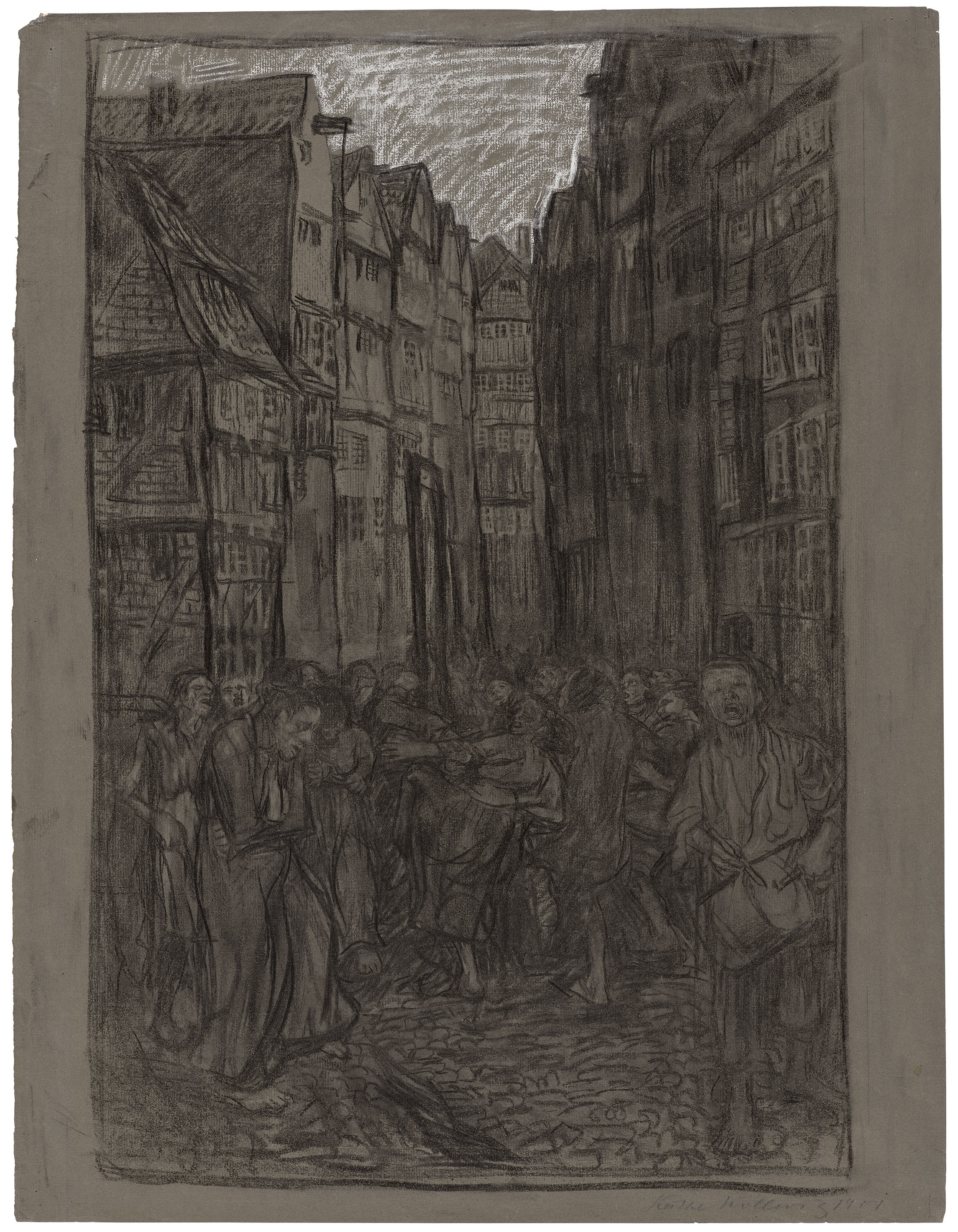
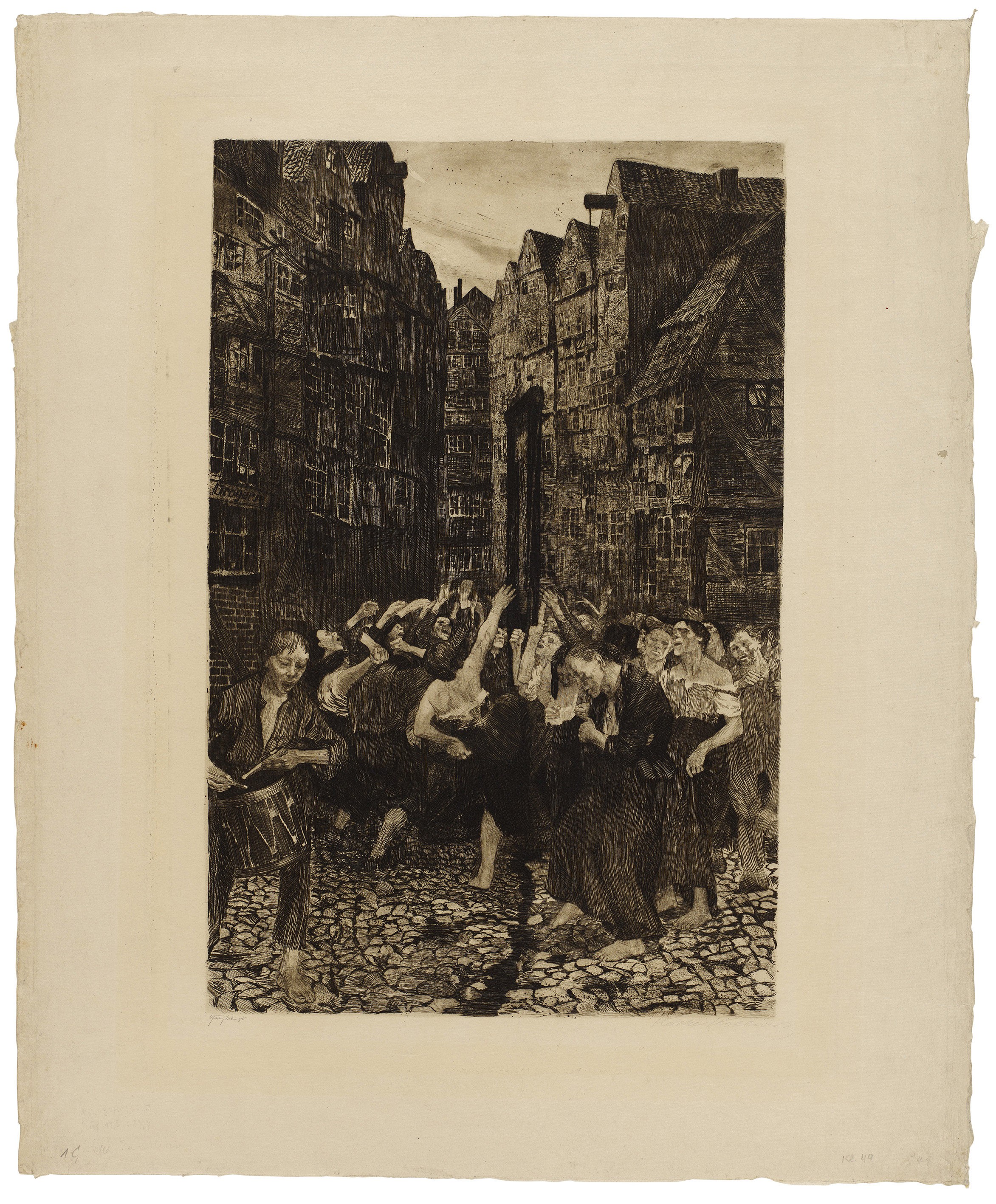
Käthe Kollwitz was inspired by Charles Dickens’ »A Tale of Two Cities« (1859) to create this etching. In his novel, he described the period of the French Revolution (1789–92) in London and Paris. In one scene, hundreds of people dance to the popular revolutionary song »La Carmagnole«, while their revolutionary fervour descends into a frenzied ecstasy. This battle hymn of the French Revolution had emerged in 1792 when Carmagnola was taken. Each stanza ends with the refrain »Dansons la Carmagnole / Vive le son du canon« (»Let’s dance the Carmagnole / Long live the sound of the canon«).
In Kollwitz’ etching the figures in rags, most of them women, dance in an ecstatic frenzy around the guillotine to the rhythm of a drummer boy. Strangely, she set the Parisian scene in a German town. The architecture with its high, half-timbered houses is said to have been inspired by a visit to the Gänge district in Hamburg. The setting may, however, just as well be the warehouse district in Königsberg, the artist’s hometown.
The historical event was also transported into the artist’s present time, as the clothes of the workers reveal. This anachronism may have to do with the fact that Käthe Kollwitz – like many social democratic young intellectuals, including her brother Konrad Schmidt – anticipated a revolution to pave the way to a socialist utopian state.