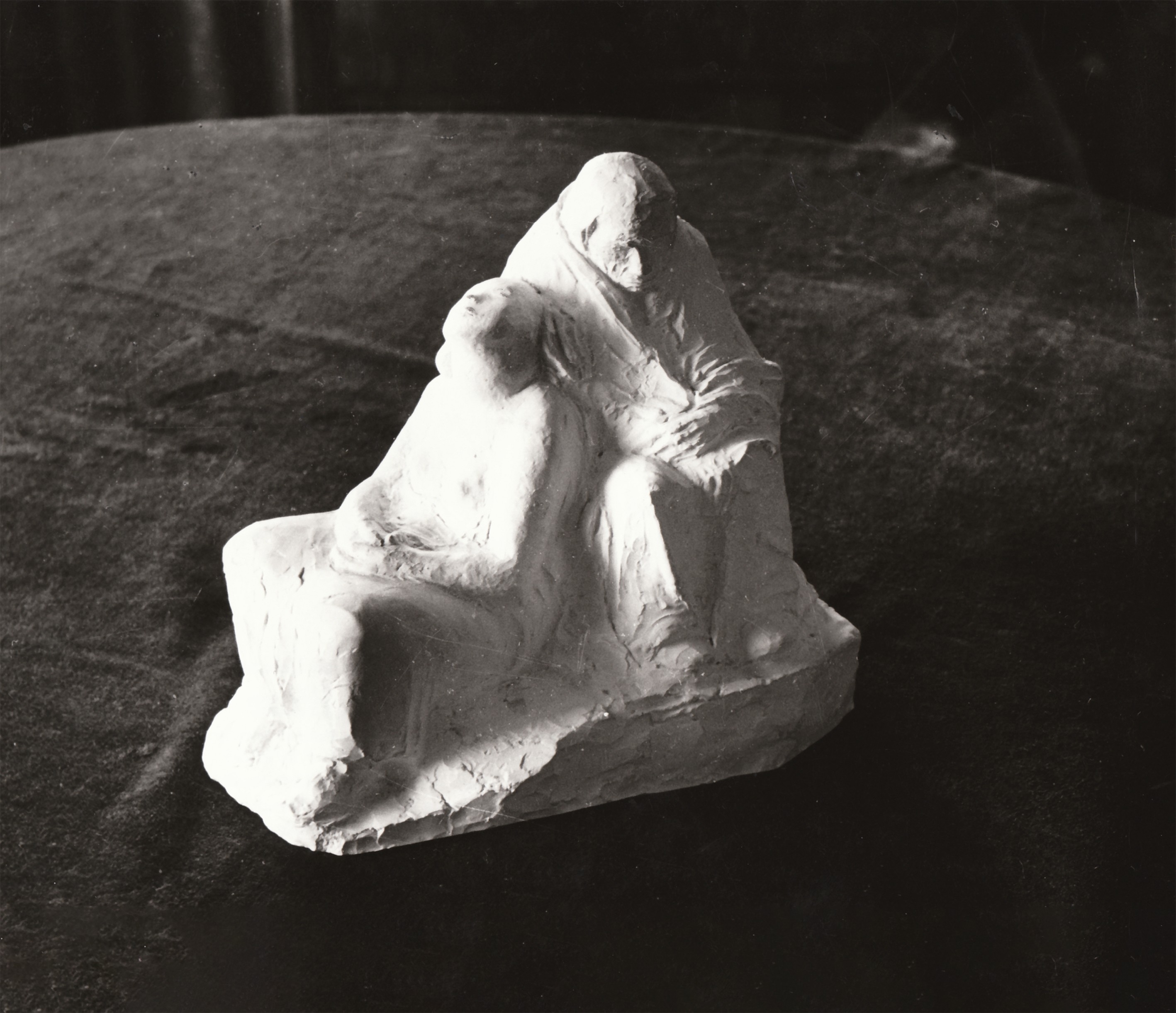
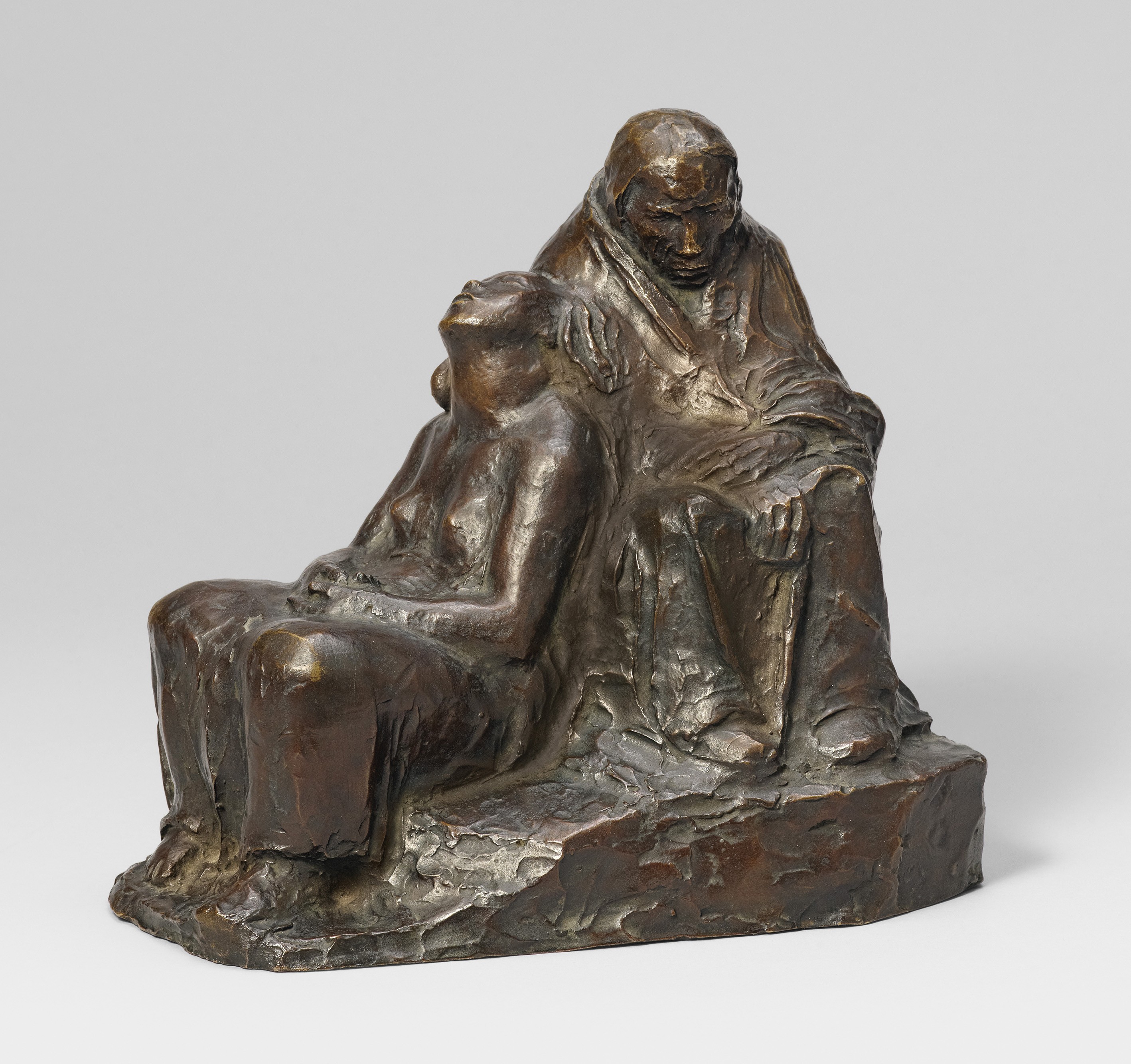
This bronze group is the last sculpture executed by the artist. It was begun in 1941, initially as a relief. In 1943 Käthe Kollwitz comments on the development of the motif in a letter to her friend Beate Bonus-Jeep:
… I have started work on something new. It has its roots in the old motif of St Anne, the Virgin and the infant Christ in ecclesiastical art. I have long been interested in this theme from a formal point of view, the depiction of a group of people, one person sitting on the lap of the other. It is going to be a relief again, although Saint Anne and Mary and the child have, almost as a matter of course, morphed into completely different people – present-day women. The young soldier’s wife has put her little child on her lap while sitting on the lap of her old mother…«
In later designs, the child disappears; the young and the old woman remain as a group. The projected relief is turned into a fully three-dimensional sculpture. In a later letter to her friend she wrote:
After a gap of several months, I am so unexpectedly fortunate to be able to do something again, it seems. Always the same theme – soldiers’ wives, an old woman. They sit together, each one lost in thought.« Käthe Kollwitz, from: Beate Bonus-Jeep, 60 Years of Friendship with Käthe Kollwitz
The group reveals clear and deliberate traces of the working process. Käthe Kollwitz played with the surface structure and highlighted profound differences between the figures. Unlike the relatively smoothly worked young woman, the older one has a coarser design and the surfaces appear uneven. The physical and material effects of the clay used for the original model have clearly been preserved in this bronze version in the shape and structure of the old woman’s cloak.
Käthe Kollwitz took the not yet fully finished work with her to Nordhausen in 1943 when she left Berlin because of the increasing number of air raids. »I love this late child of my activities and want to see it cast«, she wrote in a letter to a young colleague. This, however, was impossible to achieve in the middle of World War II. As a result, there are only posthumous bronze casts of this small sculpture.