I enjoyed working on it very much and hoped that the indissoluble feeling of togetherness is really expressed.«
Far from the city centre, in the west of Cologne, lies the Bocklemünd Jewish Cemetery. Only a few people know that a work by Käthe Kollwitz can also be found here. It is a relief on the gravestone of Franz and Doris Levy.
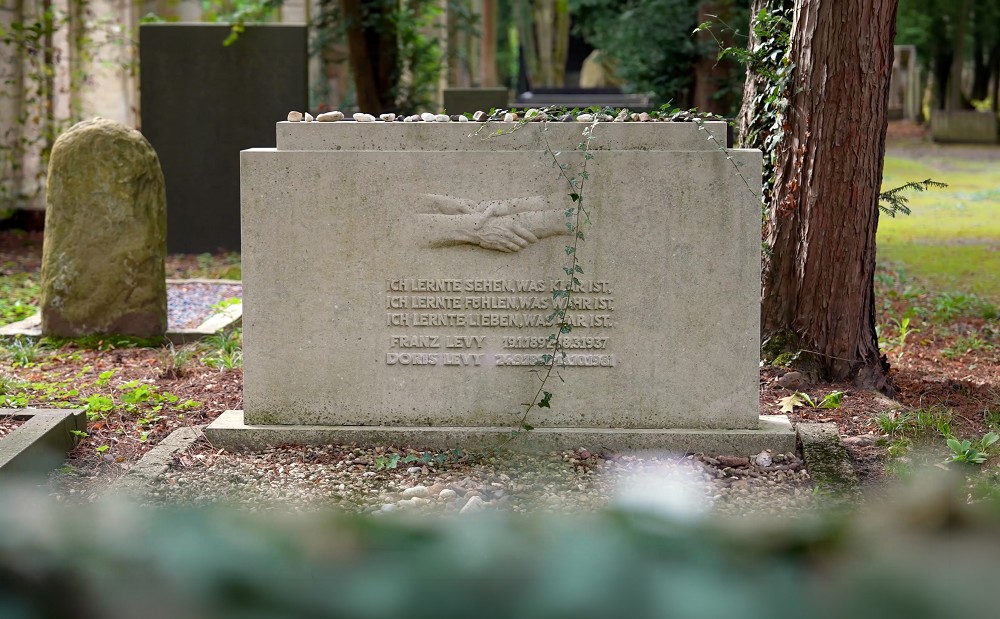
Käthe Kollwitz designed this relief in 1938 at the request of Doris Levy for her husband Franz Levy, who had died a year earlier. He was a member of the board of the Cologne-based department store group Leonhard Tietz AG (renamed Westdeutsche Kaufhaus AG in 1933 and known today as Galeria Karstadt Kaufhof) but was forced to resign from the company’s board in 1934 due to his Jewish background and subsequently founded his own business consulting firm.
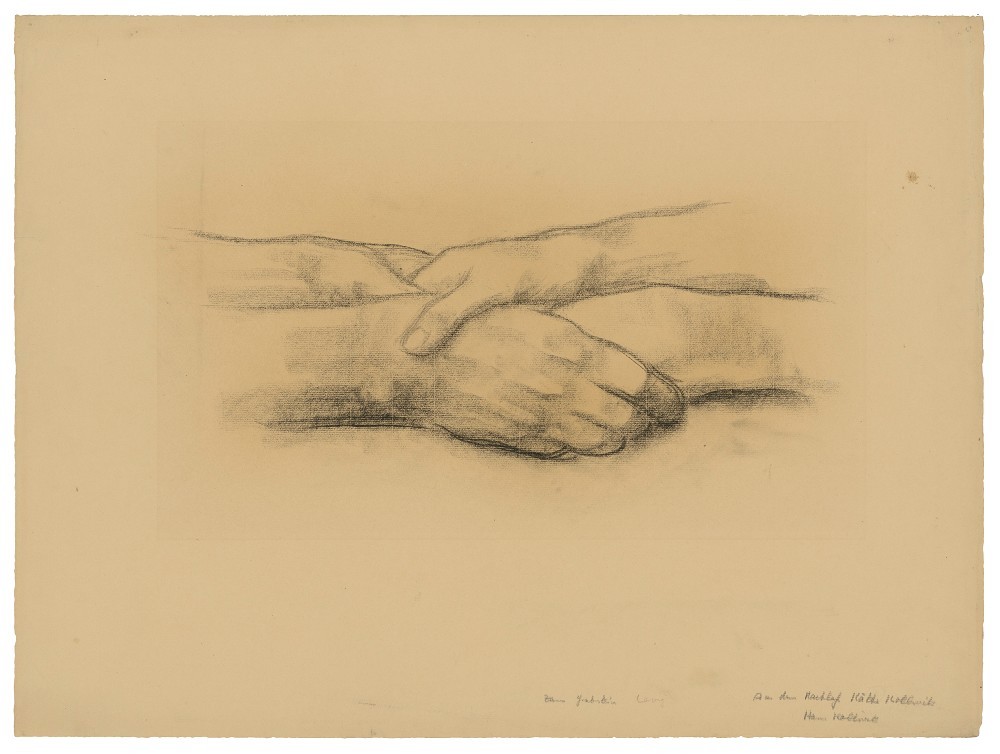
A Jewish lady in Cologne, Mrs Levy, lost her husband one year ago. She wants to set a stone for him. However, since Jewish tradition does not allow anything figurative on a gravestone, at most hands, she envisions four hands grasping each other on the stone – which she wants me to make. I gladly accepted and am looking forward to the work. I want to do it in July …«
The choice of motif cannot be justified solely on the basis of Jewish tradition; after all, hands play a significant role throughout Käthe Kollwitz’s entire œuvre as a mirror of emotions and inner emotional states. Kollwitz slowly approached the final version in several drawings, first making a clay model and later a plaster model.
The plaster model was then translated into marble by the stonemason Friedrich Bursch. In this version, the expression becomes enhanced: The tendons of the front hand now stand out clearly and lend the work an extremely lively character. What can be seen is an intimate moment of giving support and at the same time taking leave.
A Sign of Universal Human Solidarity
In view of the fact that the gravestone was created during the Nazi era for a Jewish couple, the clasping hands appear not only as an intimate symbol of the love of two spouses, but also as a universal sign of human solidarity and mutual commitment.
Käthe Kollwitz expressed her sympathy for the Jewish population in a letter to Doris Levy after the pogrom of 9 November 1938:
I have thought of you repeatedly, dear Mrs Levy,
my thought went not only to the gravesite, but to you.
Believe me, we all suffered together and deeply.
We feel both pain and shame. And indignation.«
The couple’s two sons, Henry and Helmut, were taken to safety in Britain on one of the Kindertransporte (children’s transports) at the end of 1938. Doris Levy and her daughter Marlies also finally emigrated there in 1939.
Doris Levy died in 1981.
The inscription on the gravestone, which is probably not by Kollwitz, reads:
I LEARNED TO SEE WHAT IS CLEAR,
I LEARNED TO FEEL WHAT IS TRUE,
I LEARNED TO LOVE, WHICH IS RARE.
FRANZ LEVY 19.01.1892–18.3.1937
DORIS LEVY 24.9.1892–12.10.1981
The Bocklemünd Jewish Cemetery was inaugurated on 8 December 1918 as the successor to the Jewish Cemetery in Cologne-Deutz and is still used as a burial place today. The cemetery was designed by the Cologne-based architect Karl Bing, and the cemetery building and mourning hall were created by Robert Stern between 1927 and 1929 in the neoclassical style.
Adress:
Bocklemünd Jewish Cemetery
Venloer Str. 1152
50829 Köln
Location:
Corridor 1a, Gravesite 60/61
Opening hours:
1 April – 31 October
Sundays and bank holidays 9:30 am – 6:00 pm
Monday – Thursday 8:30 am – 6:00 pm
Fridays and Jewish High Holy Days 9:30 am – 2:00 pm
1 November – 31 March
Sundays and bank holidays 9:30 am – 5:00 pm
Monday – Thursday 8:30 am – 5:00 pm
Fridays and Jewish High Holy Days 9:30 am – 2:00 pm
Please note:
The cemetery is closed on the Shabbat (Saturday) and Jewish high holy days.
On the eves of the Shabbat (Fridays) and Jewish High Holy Days, it closes at 2:00 pm.
Visiting rules and further information