
From 1901 to 1913 Käthe Kollwitz was a member of the Berlin Secession.
The artist made her first visit to Paris, visited galleries and exhibitions and met the painter and graphic artist Théophile-Alexandre Steinlen (1859–1923).
The art dealer and collector Otto Ackermann (1889-1956), the husband of her fellow student Maria Slavona (1865-1931), introduced Kollwitz to Paris art galleries. She bought a pastel by the young Pablo Picasso (1881-1973) entitled »La Bête« (1900) at Ambroise Vollard and saw works by the Nabis, the Impressionists and other French artists. She later said that Édouard Manet (1832-1883) and the Impressionists had exerted a strong influence on her.
She also visited Théophile Alexandre Steinlen (1859-1923) whom she venerated as a Naturalist painter close to her own artistic ideals. She showed him a proof of her recently finished etching »Carmagnole«, Kn 51.
After Steinlen’s death in 1924 she wrote a eulogy for the Sozialistische Monatshefte magazine:
The working class […] has its own special beauty […] which manifests itself particularly strongly in Paris. […] [It is inherent] in the gestures, language, clothing of the workers, the working class masses […]. Steinlen was so deeply steeped in it that his works only revolve around this one theme. Not with a socio-ethical message in mind (that was a motif that was added later), but simply because he enjoyed presenting his Parisians in all their guises, wherever and in whatever situations he encountered them.
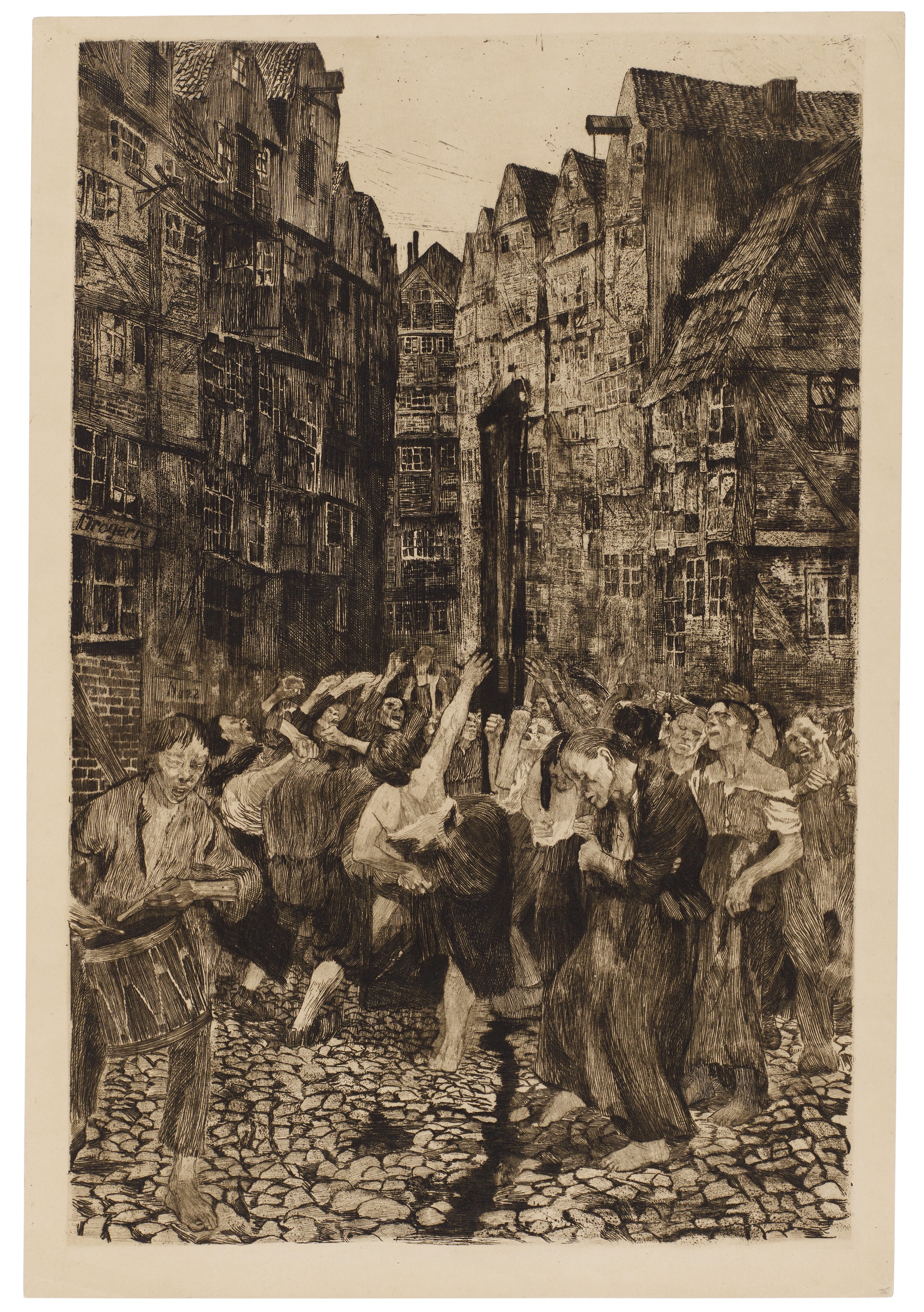
She created the large-scale etching »Carmagnole«, Kn 51, which became her calling card.
La Carmagnole is a battle song from the French Revolution that became popular when Carmagnola was taken in 1792. Each stanza ends with the refrain Dansons la Carmagnole / Vive le son du canon (Let us dance the Carmagnole / Long live the sound of the canon).
A passage from Charles Dickens’ (1812-1870) novel »A Tale Of Two Cities«, published in 1859, probably served as a literary inspiration.
After reading the »General History of the Great Peasants War« by Wilhelm Zimmermann (1807-1878) (probably the later illustrated popular edition of 1891) she began work on her second print cycle »Peasants’ War« (1901-1908).
As early as 1899 she had explored the theme in the individual folio »Uprising«, Kn 46. She originally planned to execute her later print cycle on the »Peasants’ War« as colour lithographs, but abandoned that plan in 1902 in favour of a series of etchings.
First participation in exhibitions in Paris at the Charles Hessèle gallery and in London at the International Society of Sculptors, Painters and Gravers.
It is possible that Campbell Dodgson (1867-1948) became aware of Kollwitz at the London exhibition. Dodgson, who was also in contact with Max Lehrs (1855-1938), was an assistant and from 1912 the head of the department of Prints and Drawings at the British Museum in London. He began to privately collect works of graphic art by contemporary artists, including Käthe Kollwitz. Dodgson later donated his outstanding collection to the British Museum.
Kaiser Wilhelm II (1859-1941) gave a critical comment on trends in modern art in his famous speech on the occasion of the opening of the Berlin Siegesallee – a line of statues celebrating the House of Hohenzollern:
If art, as is often the case these days, does nothing but depict misery and deprivation in a way that is even more appalling than in real life, it sins against the German people. Cultivating ideals is the greatest cultural task, and if we want to be and remain a model for other peoples, then all Germans must take part in this work. And if culture is to fulfil its task then it should reach down to the lowest strata of society. This is only possible if art gives a helping hand rather than sinking down into the gutter.
In order to improve the catastrophic housing situation in Berlin, the city council founded the König-Friedrich-Stiftung and provided it with 1 million marks.
The General Assembly of Progressive Women’s Associations met in Berlin to demand better political education and occupational protection for women.
Foundation of the Wandervogelbewegung (a German youth movement) in Berlin Steglitz.
After a first essay on Käthe Kollwitz by Max Lehrs (1855-1938), published in the Zukunft magazine in 1901, two more essays on the artist were published in 1902 – by Charles Loeser (1864-1928) in the Sozialistische Monatshefte and by Anna Plehn (no biographical data available) in Kunst für alle.
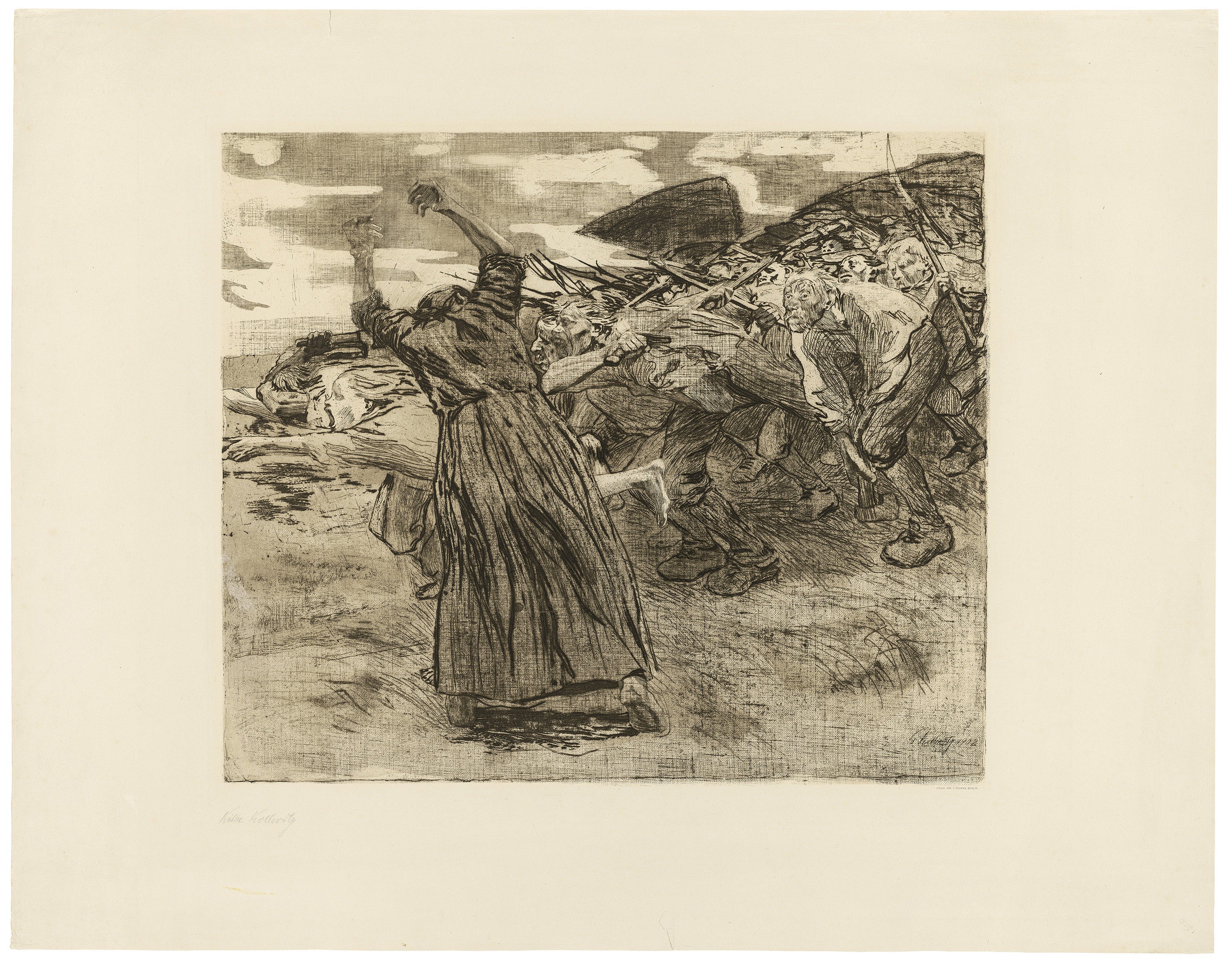
Kollwitz started work on the large-scale etching »Charge«, Kn 70, for the »Peasants’ War« cycle and the same year she presented a proof of the etching at the Black-and-White Exhibition of the Berlin Secession.
I think that the Peasants War is my best work and am rather pleased with it.«
The woman who spurs on the peasants in this folio was inspired by the ›Schwarze Hofmännin‹ - one of the few historically documented women in the Peasants’ War – who blessed and encouraged the peasants before they stormed the town of Weinsberg.
Kollwitz read about the woman in Wilhelm Zimmermann’s (1807-1878) »General History of the Great Peasants War«. Early drawings and prints suggest that she had planned to devote the entire cycle to this woman who frequently appeared in novels about the Peasants War around 1900, but who was otherwise historically undocumented.
Friedrich Lippmann (1838-1903), director of the Berlin Print Room from 1876, acquired the cycle »A Weavers’ Revolt« as well as several individual prints.
Today, the Berlin collection comprises 320 prints (proofs and final versions) and 143 drawings by the artist from all phases of her work. 120 drawings were donated by Dr Hans Kollwitz in 1964.
The New York Public Library was the first public collection in the US to acquire prints by the artist.
The art historian Max Lehrs (1855-1938), director of the Dresden Print Room, published an extensive critical appraisal including a list of the 50 Kollwitz prints from the Dresden collection in the Die graphischen Künste journal.
Kollwitz was given an entire wall at the winter exhibition of the Berlin Secession to present 25 of her works and provide an overview of her artistic activities.
The election for the German parliament saw the Zentrumspartei (Centre Party) emerge with the largest number of seats. The second-strongest political grouping was the Sozialdemokratische Partei Deutschlands (SPD) (Social Democratic Party) with 81 delegates to the new parliament. From 1890 the SPD gained the majority of votes, but as a result of the way constituency boundaries were drawn, this was not reflected by the number of seats.
Käthe Kollwitz became a member of the newly founded Deutscher Künstlerbund (association of artists), the umbrella organisation of the German Secessions and was frequently involved in their exhibitions.
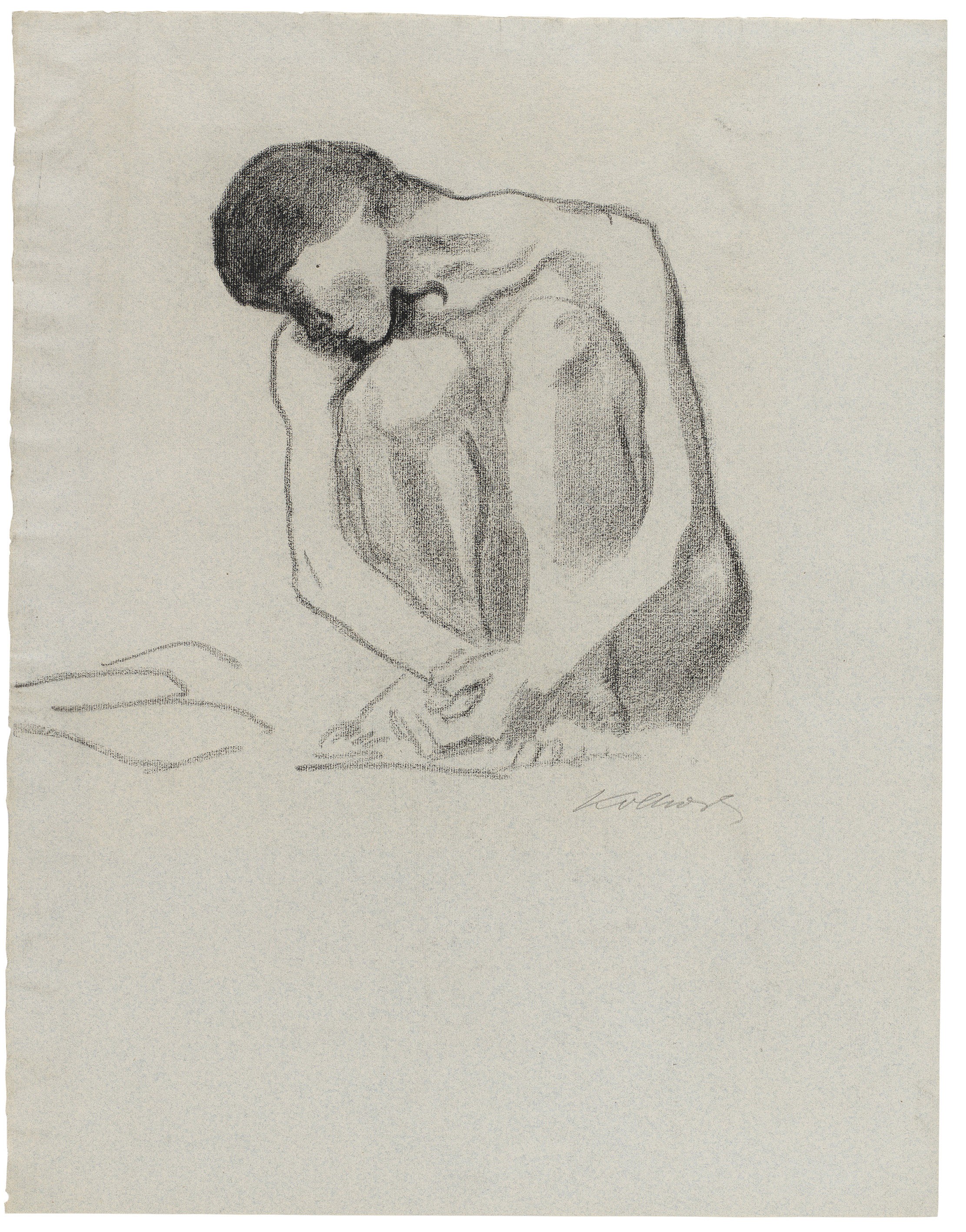
The artist visited Paris for the second time and studied at the Académie Julian for two months, presumably in the sculpting class of Raoul Verlet (1857-1923).
She visited the studios of Auguste Rodin (1840-1917) in Paris and Meudon with a letter of recommendation by Hugo von Tschudi (1851-1911).
I was entranced by Paris. In the late mornings I was at the old Julian School in the sculpture class to acquaint myself with the basics of sculpting. I spent the afternoons and evenings in the museums of the city of which I was so fond, in the cellar taverns around the market halls or in the dance bars on Montmartre.«
It was above all her visit to Rodin’s studio in Meudon which left a deep and lasting impression. Her obituary for Rodin, published in 1917 in the middle of the First World War in the Sozialistische Monatshefte, summarised her memories and the importance of the artist for her own work:
At that time there was just one artist in the entire world of contemporary sculpture – Rodin. […] What was it that made his creations so compelling, convincing and infectiously passionate? […] It was his ability to find a sculpturally convincing, substantially appropriate form for the emotional core of a theme. […] His large-scale group of lovers with their wonderfully animate hands […], his Burghers of Calais or his figure of a squatting woman – they all made me experience the strong, direct flow of excitation emanating from these works.«
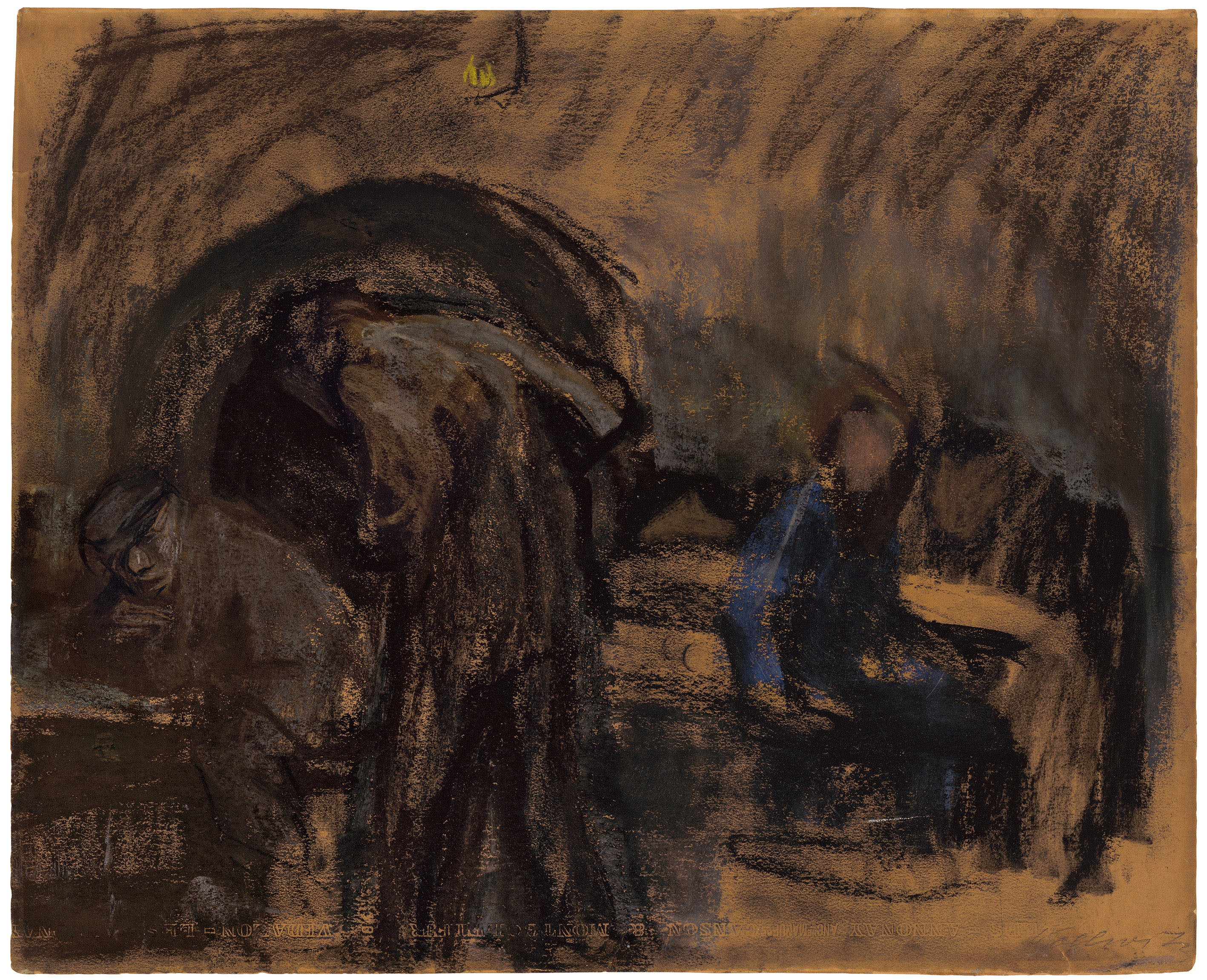
In Paris, the artist created colour pastels of the »Caveau des Innocents«, the notorious cellar taverns beneath the Paris market halls.
The Association of Historical Art commissioned Käthe Kollwitz to create the »Peasants’ War« cycle as an association gift.
In 1904, Käthe Kollwitz approached the Association of Historical Art for funding to continue her »Peasants’ War« cycle and submitted two of her latest prints – »Charge«, Kn 70, and the individual folio »Woman with Dead Child«, Kn 81.
Max Lehrs (1855-1938), director of the Dresden Print Room, assisted her in this matter as the Association of Historical Art held their convention in Dresden in 1904 and elected him member of a committee to suggest a selection of works of graphic art. It only took Lehrs ten minutes to convince the commission to accept Kollwitz’ cycle by presenting them with the artist’s best works from the collection of the Print Room.
The Kunsthandlung Emil Richter in Dresden, who sold Kollwitz’s works as early as 1899, participated in the acquisition provided that the artist transferred the selling rights to him. Between 1908 and 1910 the art dealer secured the exclusive right to edit all new prints by the artist and in 1918 acquired almost all the existing etching and lithograph plates from Käthe Kollwitz.
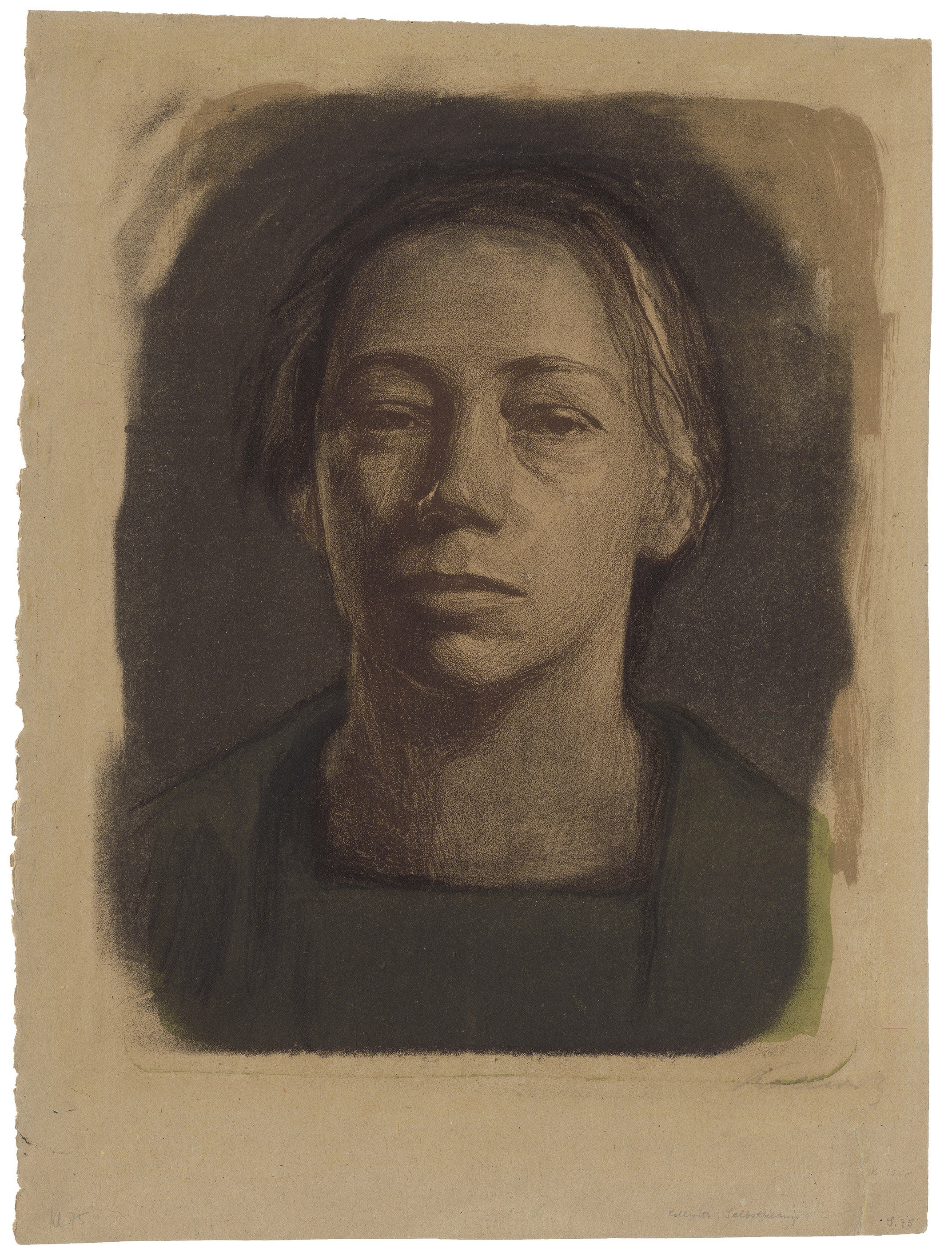
The »Self-portrait, frontal view«, Kn 85, was probably executed as a colour lithograph in 1904.
The majority of the artist's lithographs, including almost all the colour lithographs, were printed by Hermann Birkholz (?-1927) in Berlin - including the »Self-portrait, frontal view« from 1904, one of her most highly traded prints on the art market today. The few prints of this work were acquired by her most important collectors during the lifetime of the artist. They included Erich Cohn, Campbell Dodgson, Geheimrat Helferich, Ackermann & Sauerwein, Johanna and Walter Wolf, Salman Schocken and her later editor Alexander von der Becke.
Great Britain and France concluded the Entente Cordiale after settling their colonial disputes.
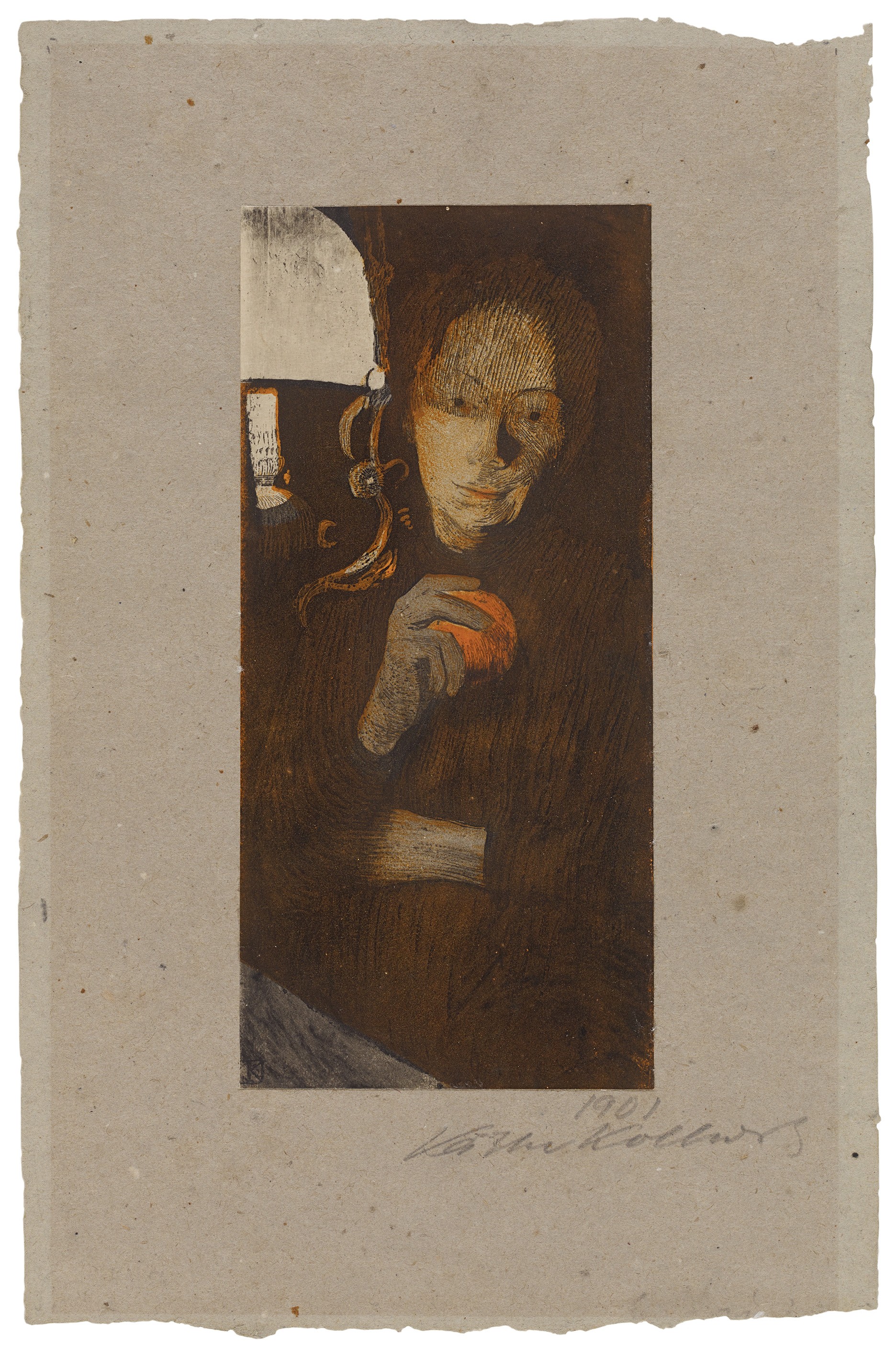
Exhibition of 13 works by Kollwitz at the Paris Salon des Indépendants.
Kollwitz presented the cycle »A Weavers’ Revolt«, Kn 33-38, the etching »Carmagnole«, Kn 51, »Hamburg Tavern«, Kn 55, the lithograph »Woman With Orange«, Kn 56, and at least one drawing – »Female nude, seated«, NT 170, which is today in the possession of the Getty Research Institute.
Alfred Graf von Schlieffen (1833-1913), German chief of general staff, submitted a secret deployment plan in the case of a war on two fronts against France and Russia. The Schieffenplan was to determine the strategy of Germany at the beginning of the First World War.
Helene Stöcker (1869-1943) founded the Association for the Protection of Mothers in Berlin. Kollwitz later gave the association some individual works. The objective of the association was the legal equality of extramarital partnerships and children born out of wedlock.
Death of the painter Adolf von Menzel (1815-1905) on 9 February.
Foundation of the Die Brücke group of artists in Dresden.
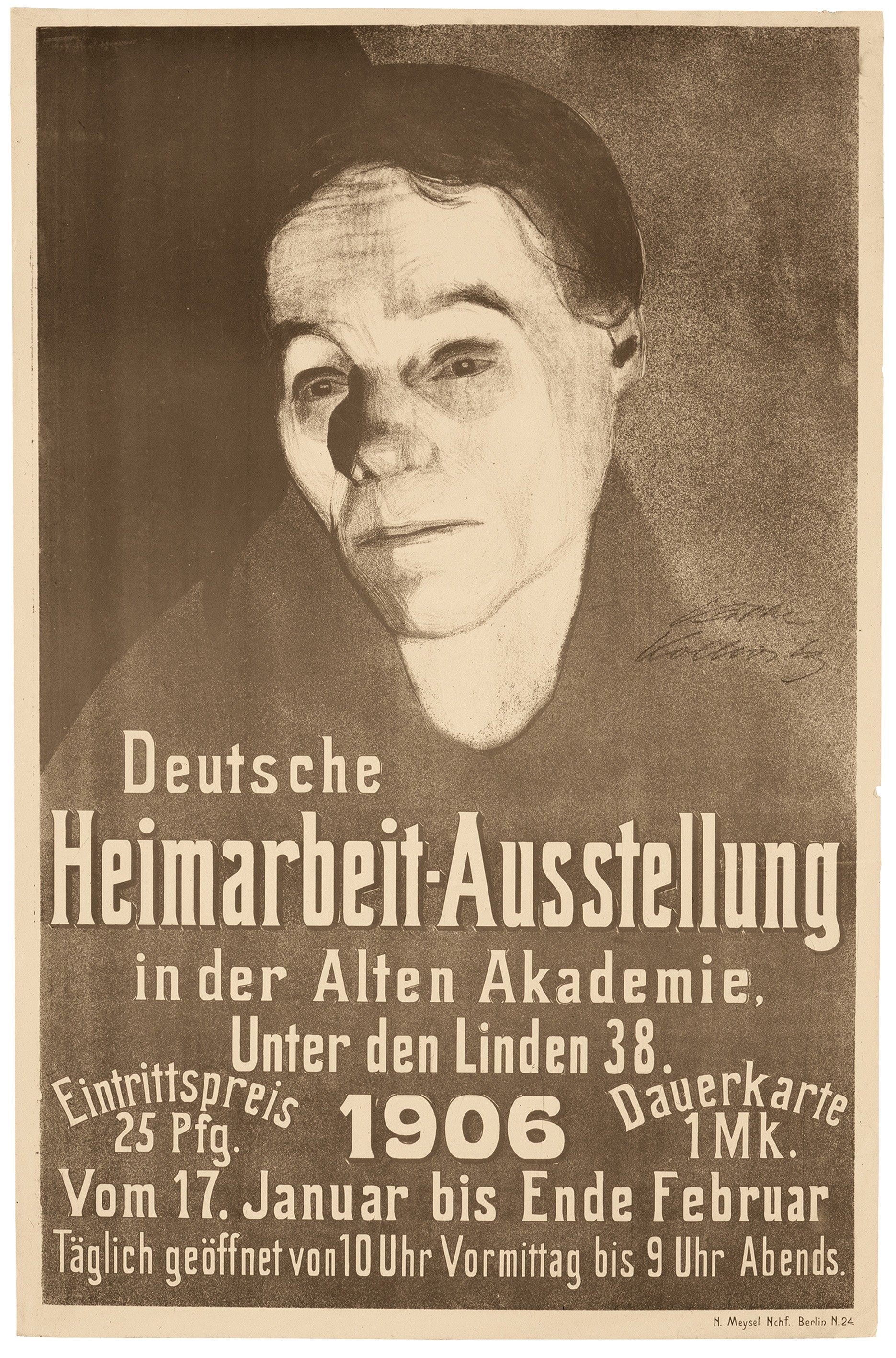
Käthe Kollwitz designed the poster »German Cottage Industry«, Kn 95, for the eponymous exhibition in Berlin.
Berlin was the centre of the German cottage textile industry. The exhibition was an enormous success and was conceived by bourgeois social reformers and labour unions. It was the first major exhibition of its kind in Germany and aimed at drawing attention to the low wages of cottage industry workers and their catastrophic working and living conditions.
There was a rumour which came up in the Weimar Republic that the Kaiserin had refused to visit the exhibition as long as the poster was publically displayed.
The launch of the British battleship Dreadnought marked the beginning of an open naval arms race between Germany and Britain.
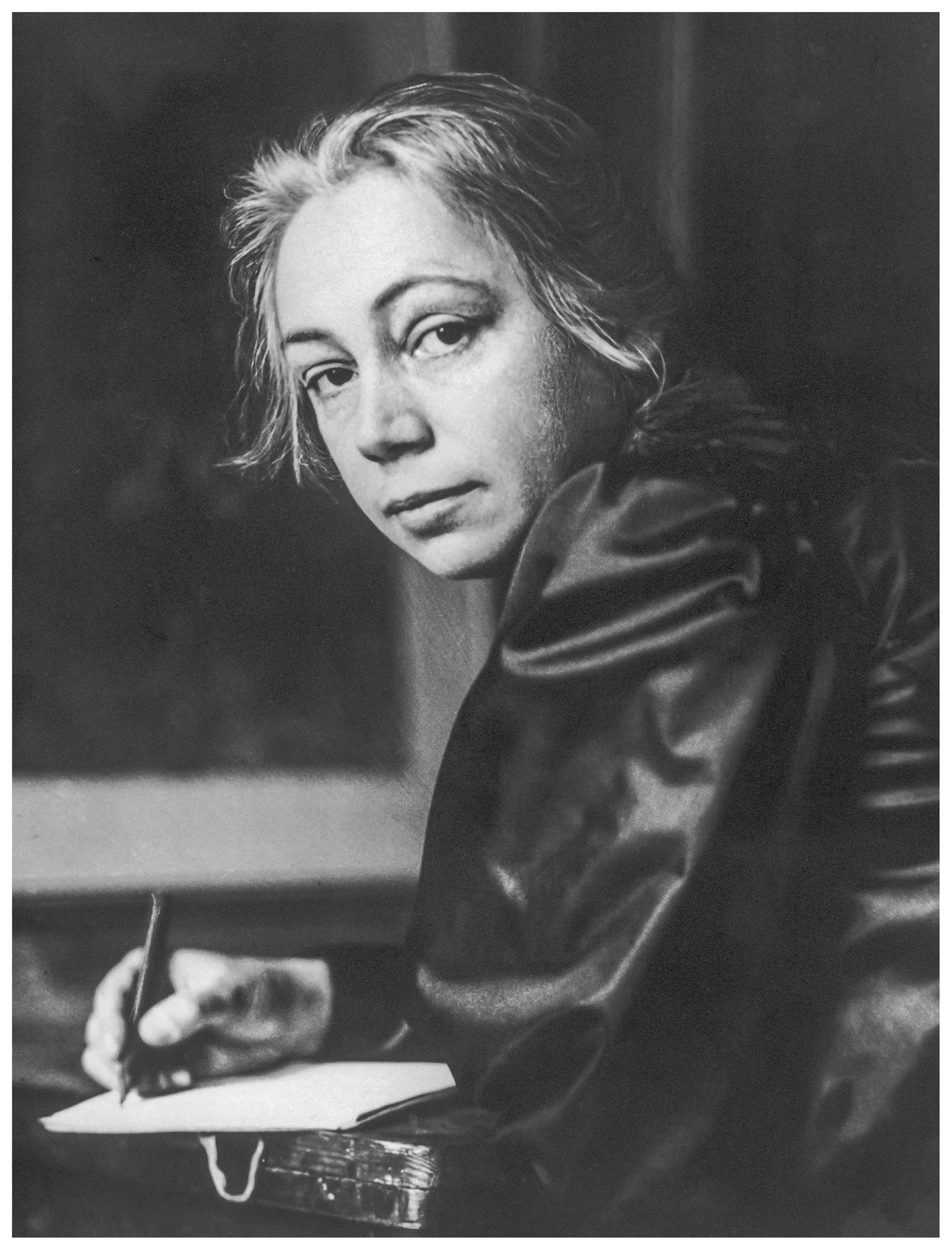
Käthe Kollwitz received the Villa Romana Prize on the occasion of the first graphic-art exhibition of the German Association of Artists.
The award, donated by Max Klinger (1857-1920), included a cash prize of 2,000 marks and an invitation for a stay of up to one year at the Villa Romana in Florence.
Käthe Kollwitz, like other award winners before her, spent only a short period at the Villa – probably a good two months.
She wrote to her sister Lisbeth from Florence:
Leaving this place to travel home will be easier for me than leaving Paris […]. The huge galleries are confusing […]. I therefore tried the churches and was a lot luckier. They contain marvellous frescoes. I have strolled through all the churches and monasteries […]. – Then there is the Bargello with all the Donatellos […]. His boys and young men are splendid, and his David is just beautiful. And finally I dare visit the Pitti and the Uffici again. They contain wonderful works […] The most impressive work so far has been Massaccio’s fresco in Santa Maria del Carmine which shows a nude boy kneeling among a group of stiff men. And then there is a Virgin with Child. The child sits on her lap, and the Virgin sits on the lap of Saint Anne.«
A hiking tour from Florence to Rome with the young, adventurous Englishwoman Constanze Harding-Krayl marked the end of her journey to Italy and was her most impressive experience.
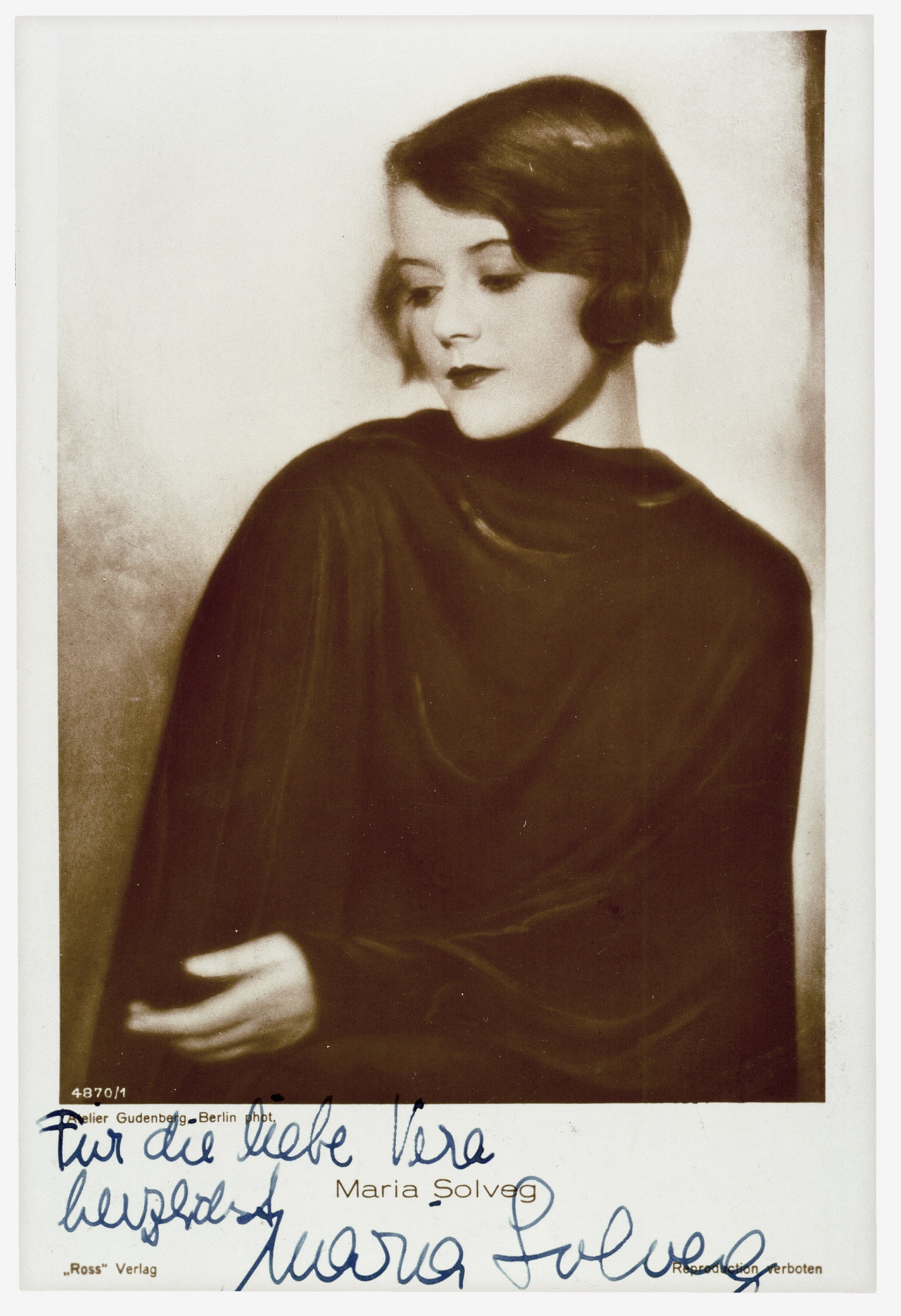
Birth of Käthe Kollwitz’ niece Maria Stern (1907-1993).
Maria Stern was the fourth and youngest child of Käthe Kollwitz’ sister Lisbeth. She became an actress, choreographer and writer. After her marriage to the Hungarian film director and actor Ernst Matray she emigrated to the US in 1933, but returned to Germany after World War II and, among other activities, wrote screenplays for TV series.
After agreements between Russia and Britain, France, Britain and Russia formed the Triple Entente. As a consequence, the German Reich became internationally isolated with the Austro-Hungarian Empire as its only reliable ally.
The SPD gained the majority of votes in the elections for the German parliament.
Foundation of the Deutscher Werkbund (a federation of artists and architects).
Käthe Kollwitz’ diary entries have been preserved from 1908 onwards.
They were not intended for publication and contain the artist’s reflections on personal matters, involvement with her work, thoughts about her relationship with others and her search for her political position.
After her son Peter (1896-1914) fell at the beginning of the First World War in 1914, the thoughts she wrote down in her diary revolved continuously around an idealistic image of her sons, Peter’s sacrifice for the Fatherland and her own attitude to the situation.
The ten-volume diary (18 September 1908 to May 1943) is kept at the Stiftung Archiv der Akademie der Künste, Berlin.
In 1908 her son Hans Kollwitz (1892-1971) became seriously ill with diphtheria and almost died. Käthe Kollwitz tried to come to terms with this situation in a number of drawings and – above all from 1910/11 – in several etchings.
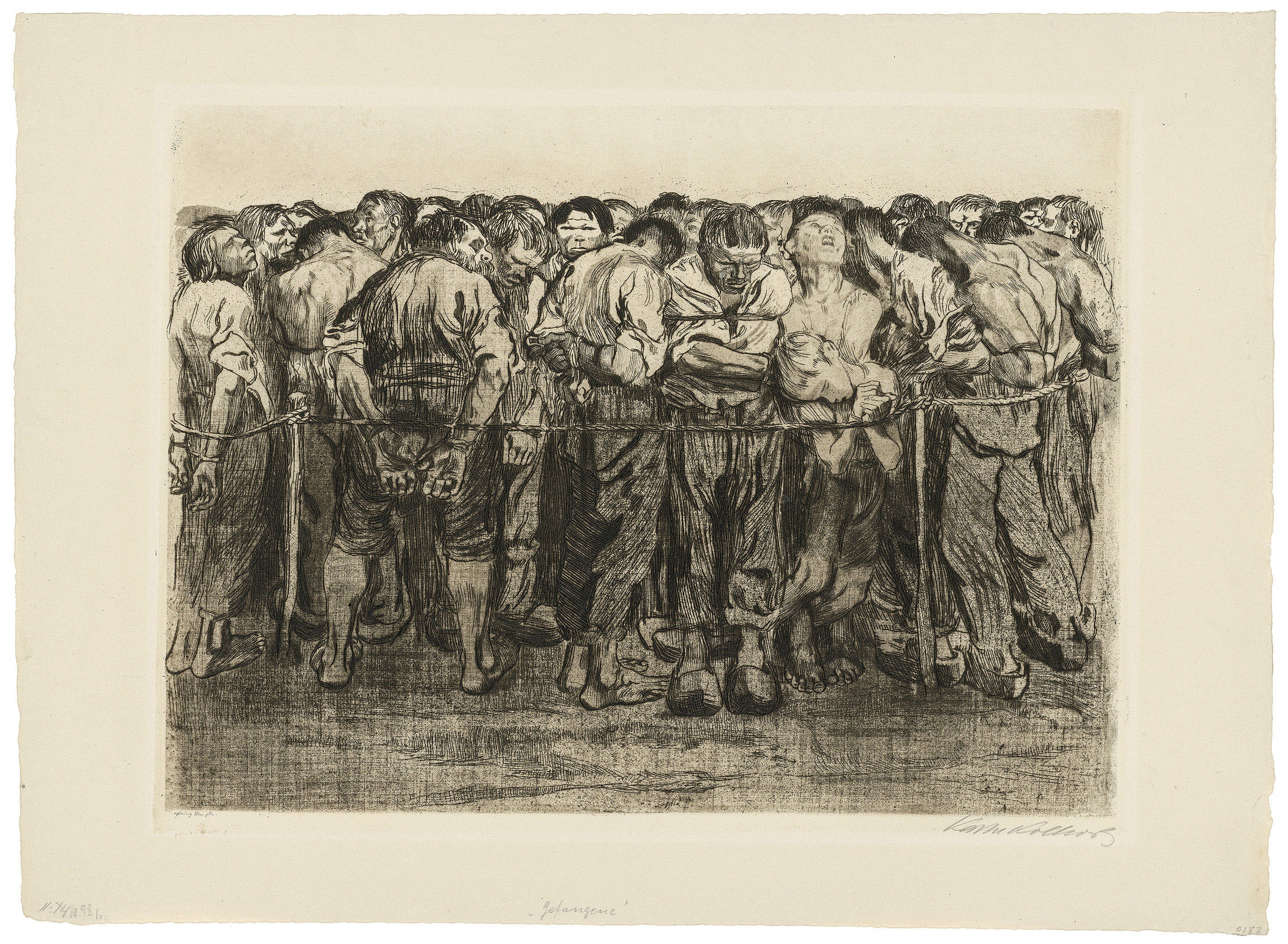
Completion of the »Peasants’ War« cycle. This print series was shown in its entirety at the Great Art Exhibition in Dresden in the same year.
The cycle gave the extent of the artist’s fame an enormous boost and marks the high point and completion of her cycles of revolutionary themes. It was printed as a gift of the Association for Historical Art.
The Kunsthandlung Emil Richter participated in the acquisition of printing plates on the condition that the artist transferred the selling rights to him. Between 1908 and 1910, the art dealer secured the exclusive right to edit all new printing plates by Kollwitz. In 1918 he acquired almost all the existing etching and lithograph plates from the artist.
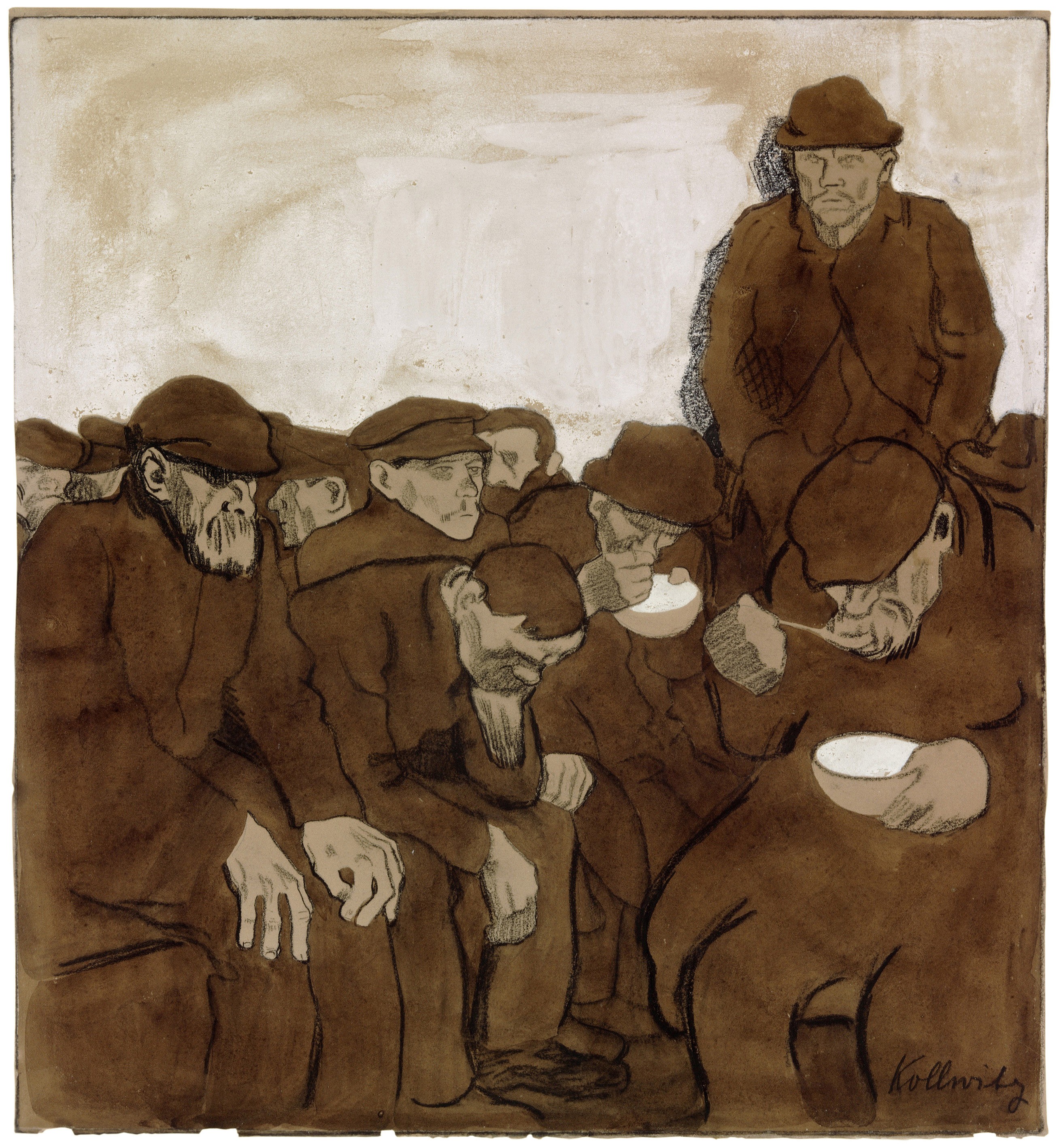
From 1908 to 1911 Kollwitz worked for the satirical weekly magazine Simplicissimus.
Around 1908 there are several diary entries on visits to female patients of her husband where she describes the severity and tragedy of proletarian life.
In 14 drawings for the satirical magazine she directly addressed the problems of the proletariat and her graphic works increasingly became an instrument of social and political commitment.
This having-to-finish-everything-in-a-rush, the necessity to express a theme in an accessible manner and at the same time – as this is for the Simpel (Simplicissimus) – the opportunity to remain on a high artistic level, but above all the fact that I can often convey to a large public what irks me again and again and what hasn’t been talked about nearly enough – all the many quiet and clamorous tragedies – this all makes my work very dear to me.«
In the autumn of 1908 Käthe Kollwitz probably began her sculptural work.
The Reichsvereinsgesetz (law of association), passed in April 1908, allowed membership and activity of women in political groups. This did not, however, include an active or passive voting right.
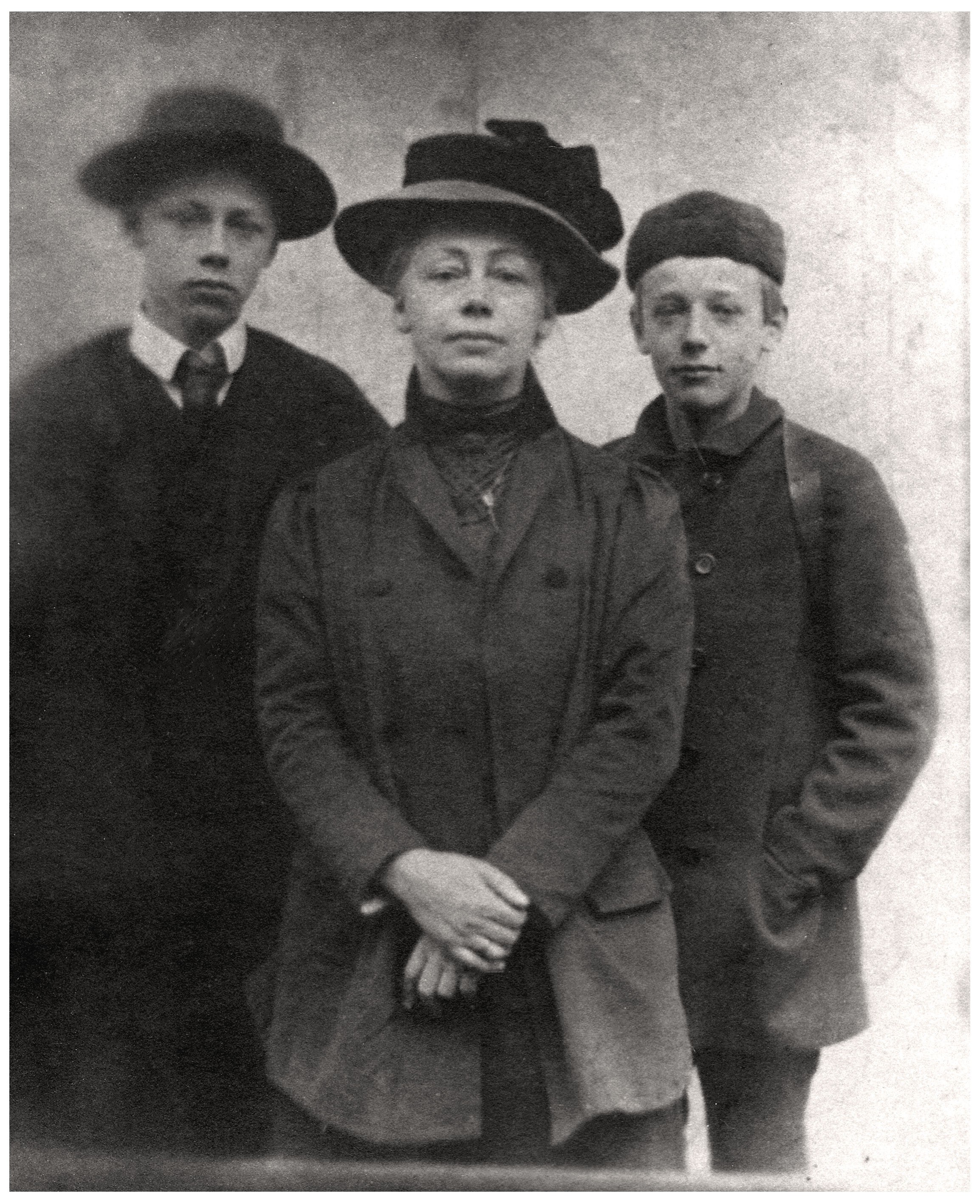
Käthe Kollwitz took part in the celebrations on the occasion of the 100th anniversary of her grandfather’s Julius Rupp (1809-1884) birth in Königsberg.
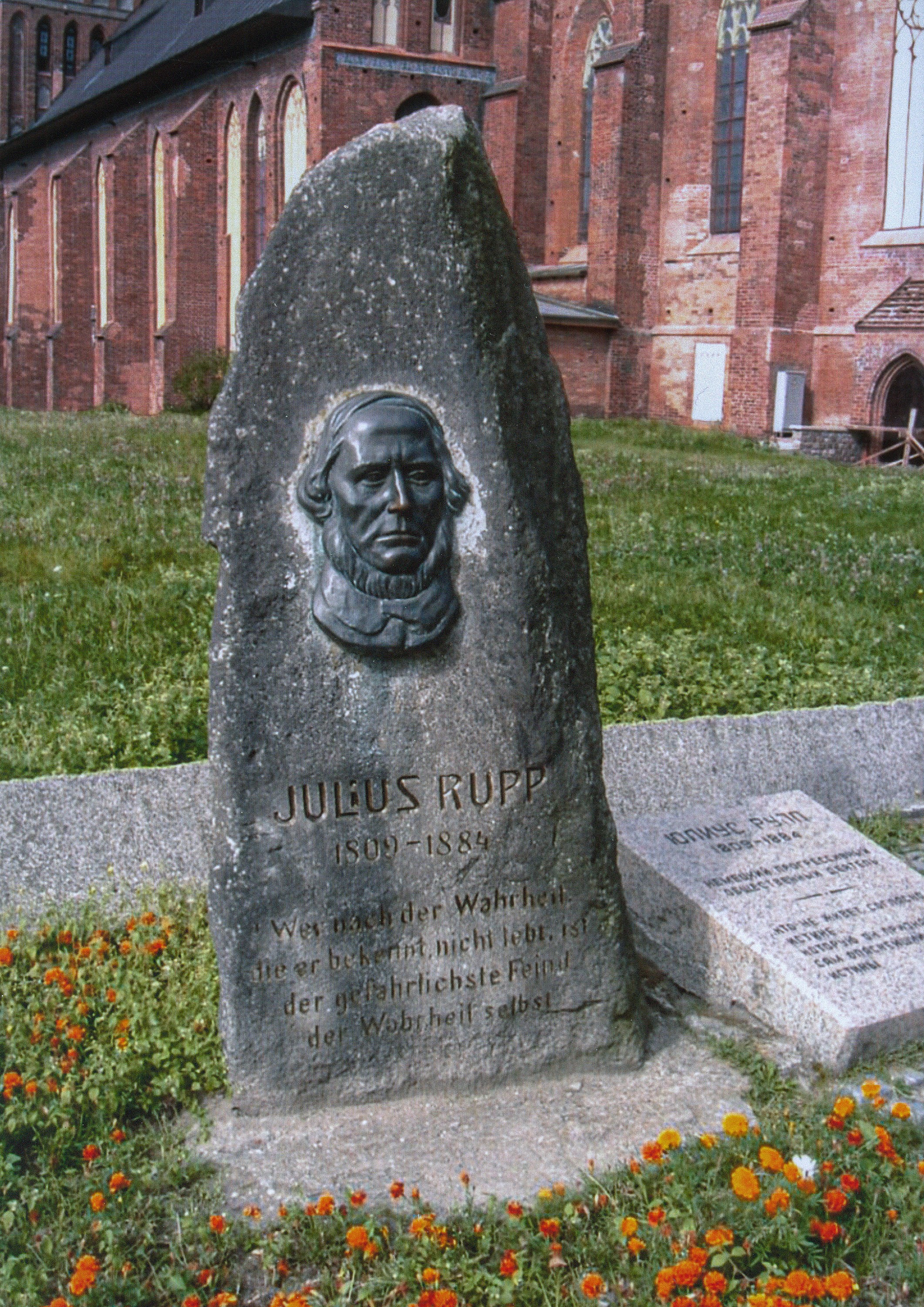
The artist’s first sculptural work was the »Portrait Relief Julius Rupp«, S 01 – an image of her grandfather. On the occasion of the 100th anniversary of his birth the Free Evangelical Community honoured their founder with a commemorative stone which included the bronze relief by Käthe Kollwitz.
After World War II, in which the relief was lost, it was reconstructed by mistake after Käthe Kollwitz’ painting of her father. It was only in 1990 that a faithful reproduction by the Berlin sculptor Harald Haacke (1924-2004) cast at the Berlin Noack foundry replaced the original relief.
For the first time the artist was represented at the Biennale in Venice with a total of 13 works – among them the »Weavers cycle« and several folios from the »Peasants’ War«.
Kollwitz executed the six drawings for the »Images of Deprivation« series that were published between October 1909 and January 1910 in the Simplicissimus.
Creation of an unspecified graphic work for the Association for the Protection of Mothers.
Foundation of the Expressionist group of artists Neue Künstlervereinigung which included Wassily Kandinsky, Gabriele Münter, Alexej Jawlensky, Marianne von Werefkin and others.
First flight of a zeppelin over Berlin on 29 August.
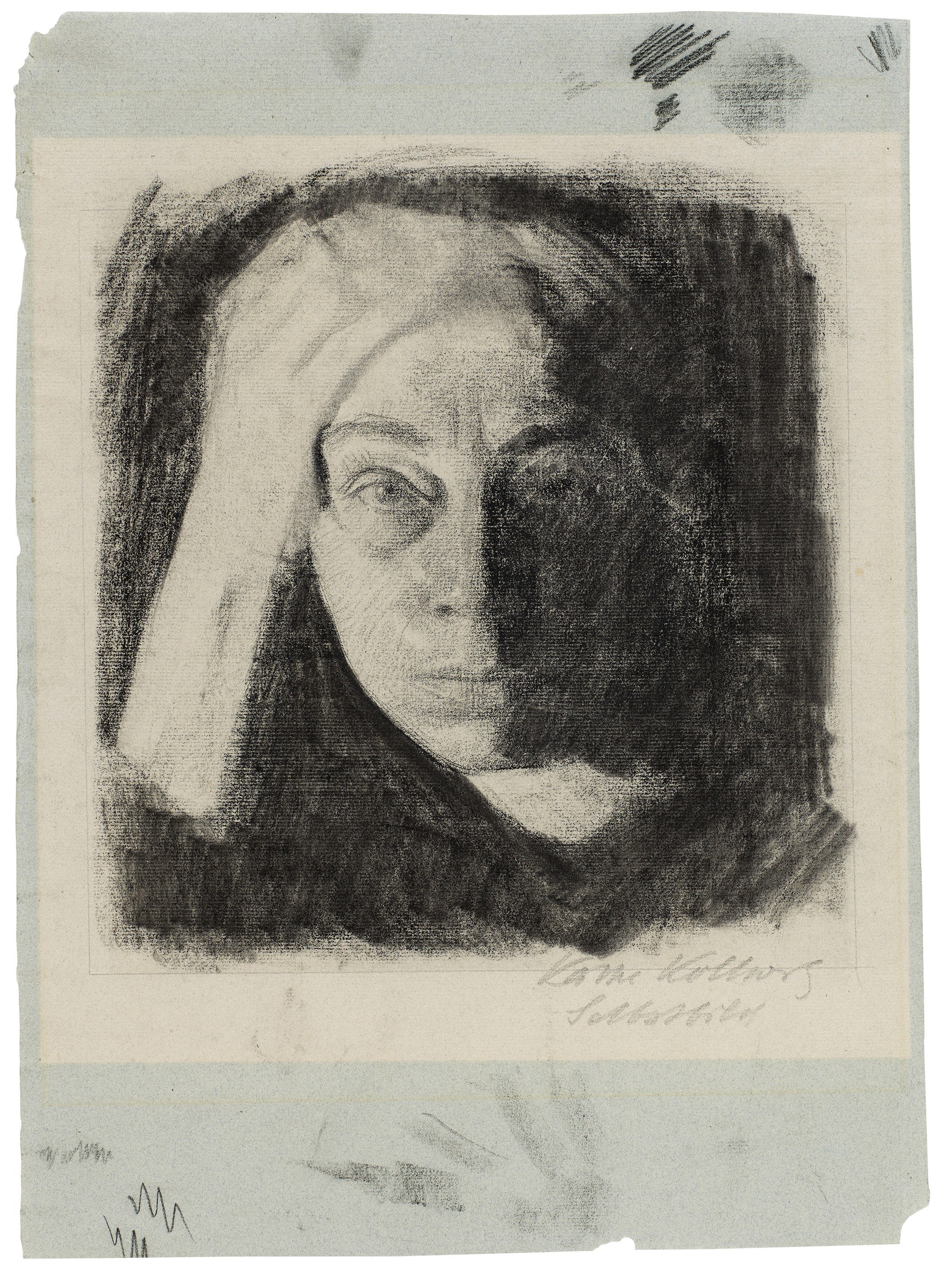
Käthe Kollwitz attended the Abendakt (evening class for nude painting) at the sculptor Arthur Lewin- Funcke’s (1866-1937) private school for painting and sculpting – probably in the context of her increasing orientation towards sculptural works.
Her eldest son Hans Kollwitz (1892-1971) started a degree course in medicine.
In spring 1910 the artist addressed the topic of Expressionism for the first time in her diaries.
When several Expressionists left the Berlin Secession in 1910 to found the Neue Secession, Käthe Kollwitz initially referred to their works as ›talented scribblings‹ [in: Tagebücher (Diaries), April 1910].
After visiting a Black-and-White Exhibition of the Neue Secession in early October 1910, the artist finally saw the positive aspects of this new trend, and her woodcuts from the 1920s are clearly Expressionist in character:
I am beginning to have an idea why this trend could have something positive. It is provocative, effective and must do the devil’s work.«
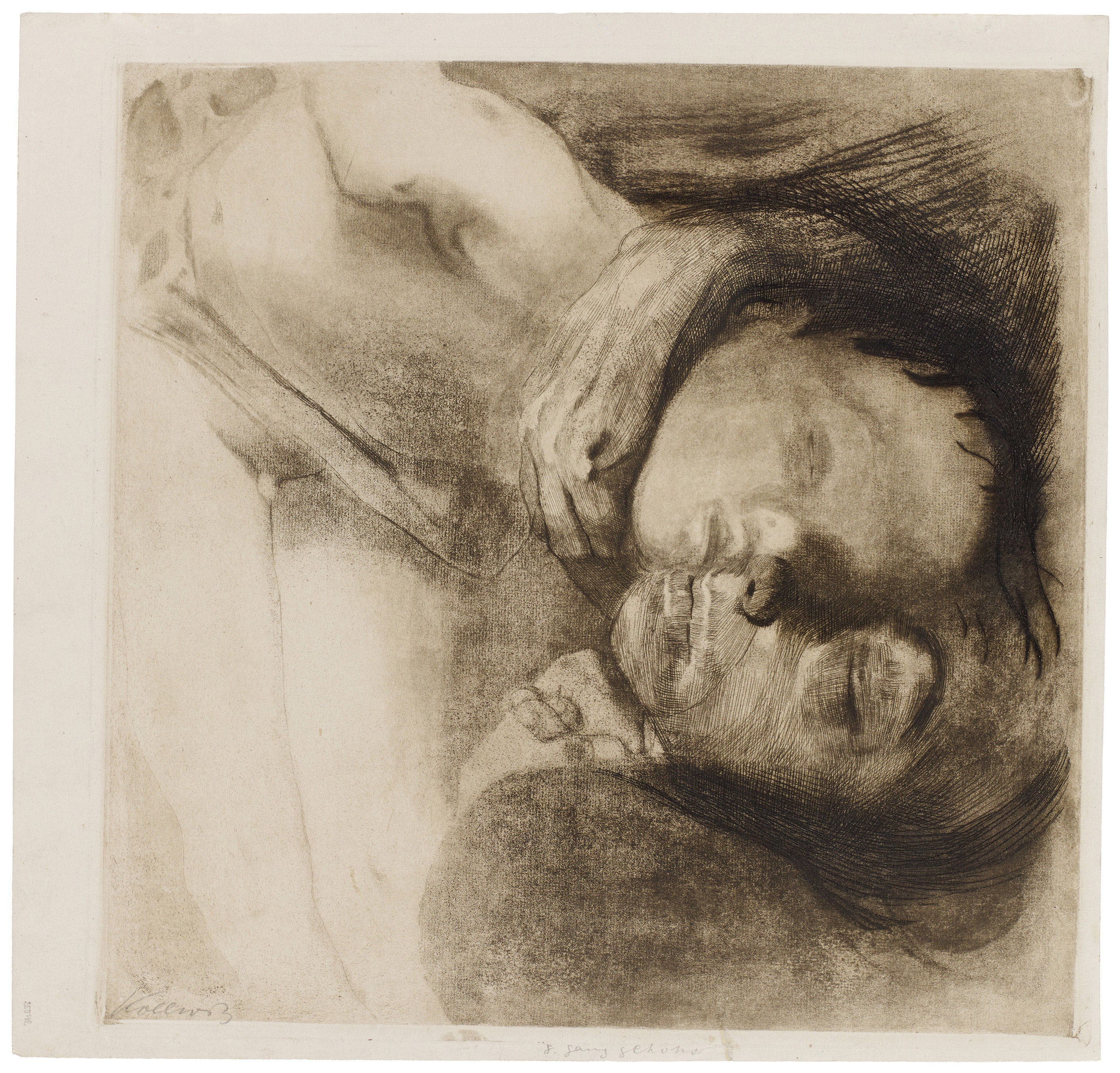
Around 1910/11 the artist created a large number of etchings on the theme of ›Death‹ after drawings in which she was preoccupied with the life-threatening diphtheria infection of her son Hans Kollwitz (1892-1971) in 1908.
Käthe Kollwitz drew in-situ sketches at the Moabit riots.
For three nights now there have been riots in Moabit. 50 workers were on strike at the coal depots of Kupfer […] On the 2nd or 3rd day I went to Beusselstrasse. […] The street was packed with workers. […] The atmosphere was very tense […]. In front of the church there was a line of policemen on horseback. As I was leaving, the street began to be cleared. […] The Kupfer coal lorries only do their deliveries under police protection and cause a lot of emotion and ill feeling.«
The Moabit riots in Berlin, which started among workers at a coal merchant’s firm, eventually involved up to 30,000 people who took part in violent clashes between striking workers and the police.
Käthe Kollwitz supported the Juryfreie Ausstellung (jury-free exhibition) founded by Hermann Sandkuhl (1872-1936), but had to give up her support under pressure from the Berlin Secession.
At a mass rally in Berlin-Treptow 200,000 people demonstrated against warmongering and for peace among nations.
On the first International Women’s Day people in Denmark, Germany, Austria, Switzerland and the US demonstrated for women’s voting right and emancipation. 45,000 women took part in rallies in Berlin alone.
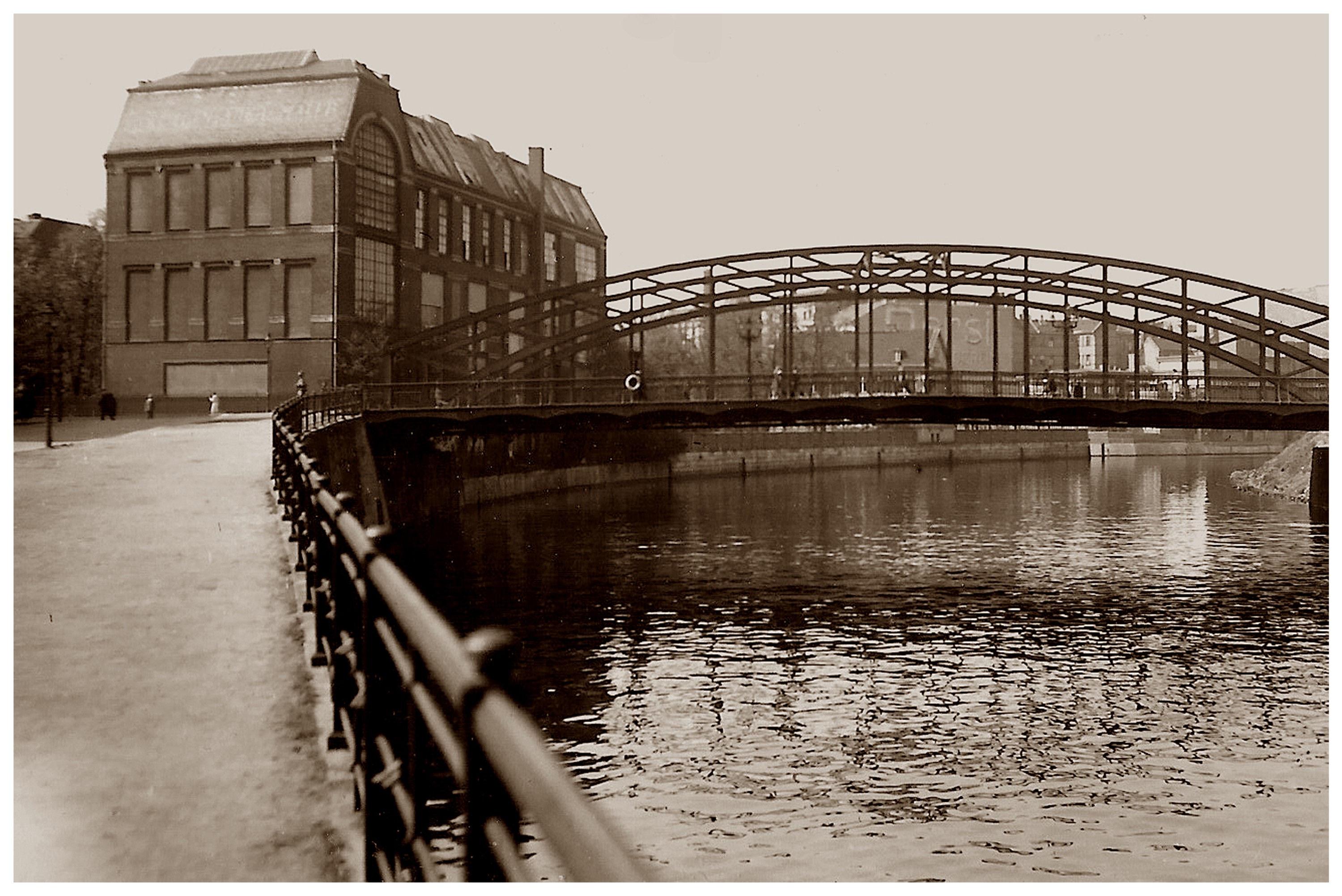
From September 1912 to autumn 1928 Käthe Kollwitz rented a studio at the Berlin Siegmundshof for her sculptural work.
For her etching »Carmagnole«, Kn 51, the artist was awarded the Goldene Salzburger Staatsmedaille.
From 1912 Kollwitz was an elected board member of the Berlin Secession. After its split in 1913 she joined the Free Secession and was a board member from 1914 to 1916.
Her youngest son Peter Kollwitz (1896-1914) started a degree course in art at the training class of the Berlin Museum of Applied Art.
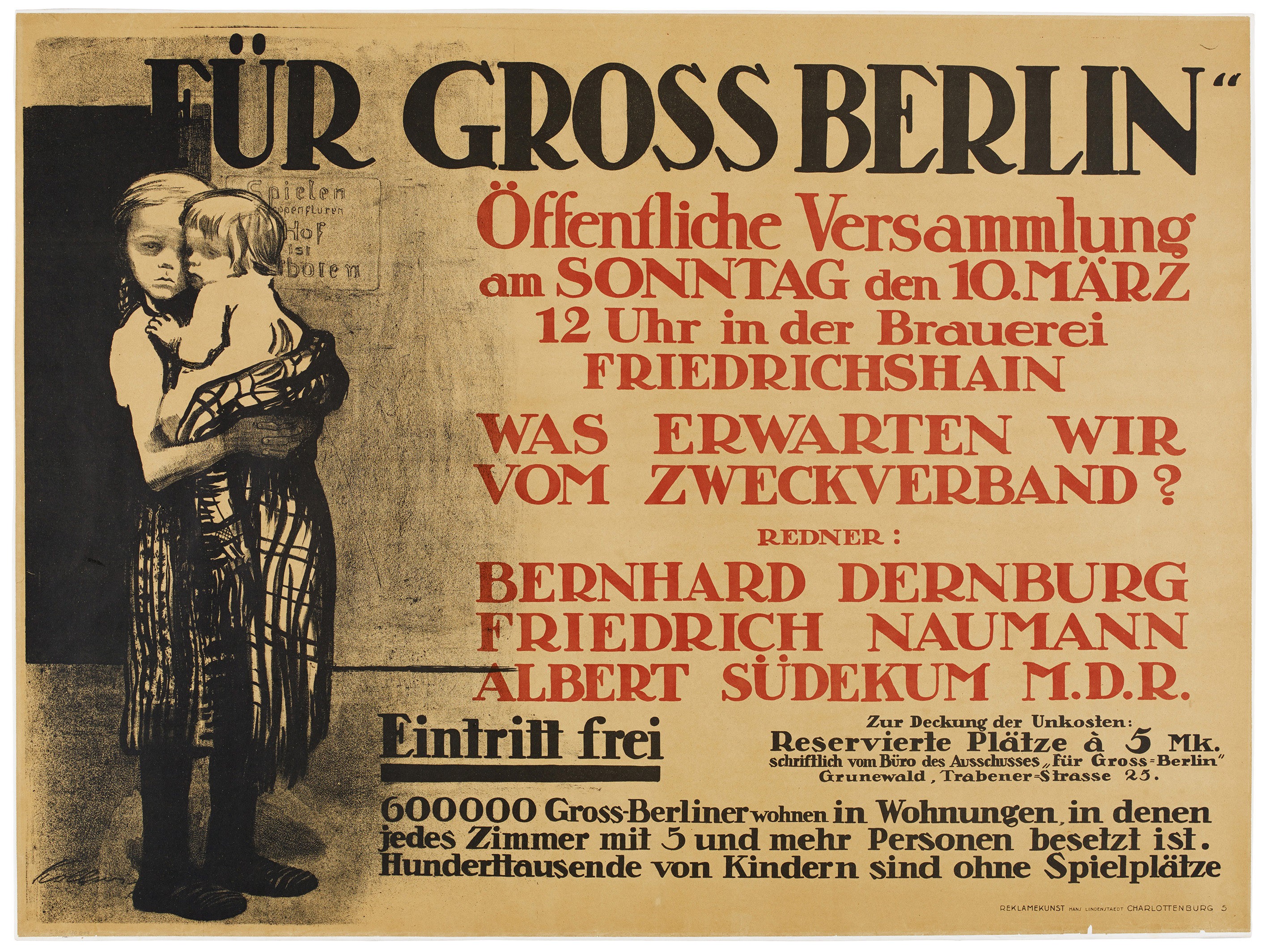
The artist designed a poster for the propaganda committee »For Greater Berlin«, Kn 122. Following an intervention by the association of homeowners, chief of police Traugott von Jagow (1865-1941) banned the poster for ›incitement to class hatred‹.
Berlin and its metropolitan area saw a massive inward migration from the late 19th century. As a reaction, several communities founded the Zweckverband Groß-Berlin (Greater Berlin Administration Union) in 1911 in order to coordinate housing projects, protect recreational areas and unify public transport.
In 1912 architects and town-planners who found that their views had not been sufficiently taken into consideration founded a propaganda committee and used the poster to call for demonstrations.
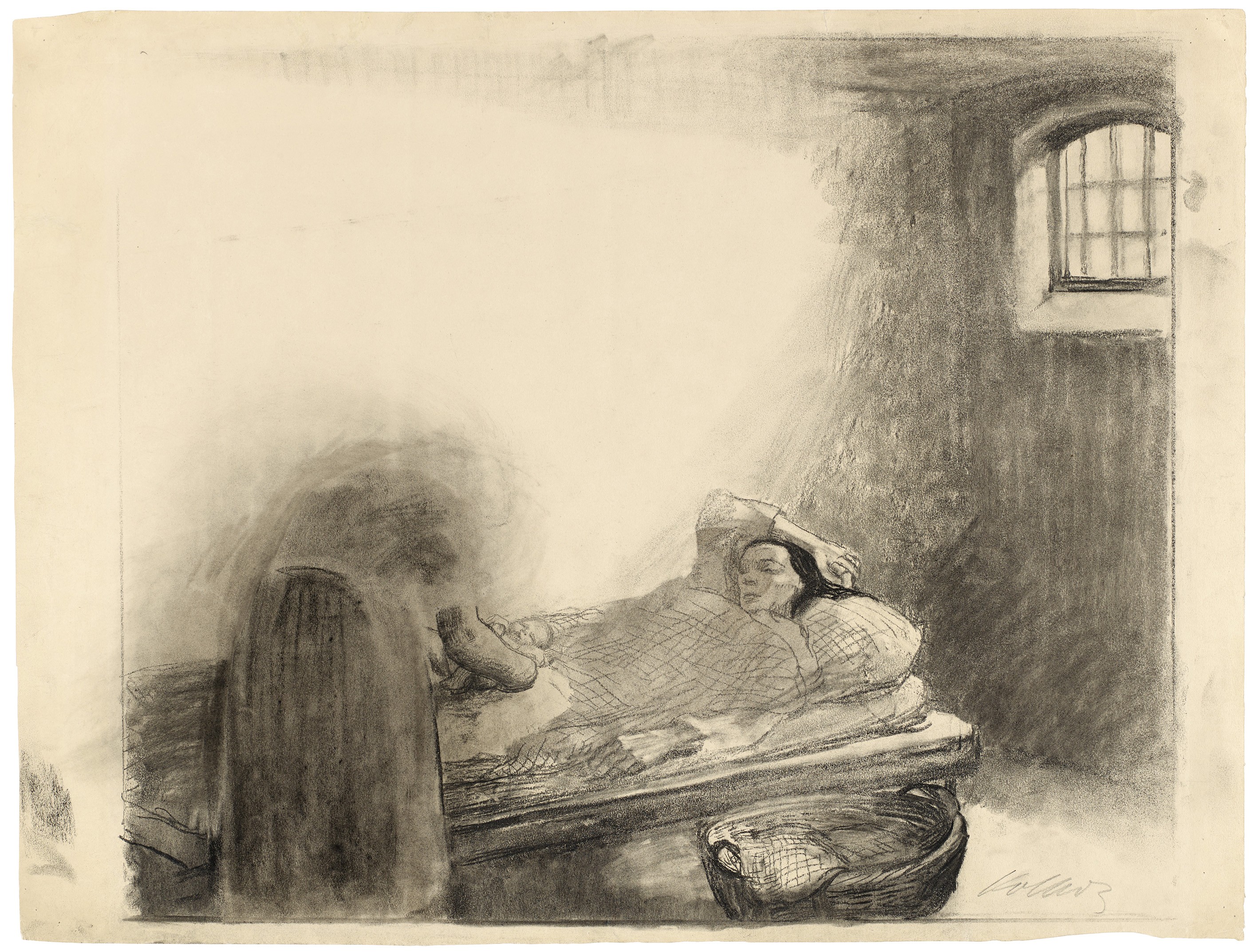
The artist contributed two drawings – today not clearly identifiable – for the Berlin exhibition Die Frau in Haus und Beruf (Women at Home and Work).
Her works were to be included in a 13-part pictorial broadsheet in the section Die Frau in der Wohlfahrtspflege (Women in Social Welfare Work), in which women artists explored the development of social care for female prisoners in the 19th century. For this reason, the authorities in Berlin for the first time granted permission to make drawings in prisons.
I found it very interesting to visit the local women’s prison – which is still referred to as ‘Weibergefängnis’ on a sign. The second time I was there I had to wait in the waiting room for some time. There were two women who had come to visit their sons who were in custody. One of them was crying her eyes out. A third woman then said: ›Stop crying. If you cry life becomes even sadder.‹ There was such a strain of misery and emotional suffering in that room – horrible!«
The exhibition Die Frau in Haus und Beruf (Women at Home and Work), organised by the Berlin Lyceums Club gave an overview of the activities of the 9.5 million working women in Germany and included the areas of education, farming, social work, trade and transport, nursing and journalism. In the fine-arts section, a selection of 250 works by women artists from Germany, Paris, London, Florence and Rome were exhibited.
Until 1918 Käthe Kollwitz focused increasingly on her sculptural work. In the following three years she – among other projects – worked on the theme ›Lovers‹ which culminated in 1915 in her »Group of Lovers«, S 13.
In the elections for the German Reichstag, the SPD gained more than 4 million votes, and thus over a third of the votes, and became the largest party in parliament. Many Social Democrats had abandoned their former revolutionary positions in expectation of a peaceful transfer of power.
On 20 October, following an appeal by the SPD, 250,000 people demonstrated in Berlin for a democratic voting system in Prussia and against rising food prices and the danger of war.
At this mass rally, in which Käthe Kollwitz, her husband and her son Peter took part, the participants decided – by a show of hands – to issue a resolution to fight together with the workers of all countries against war as a concomitant symptom of imperialist policy.
Gerhart Hauptmann (1862-1946) was awarded the Nobel Prize for Literature.
Titanic disaster
After the split of the Berlin Secession, Käthe Kollwitz joined the Free Secession and became a member of the board from 1914 to 1916.
She was one of the founders of the Women’s Art Association and its first chairperson until 1923.
After several unsuccessful petitions – which Käthe Kollwitz had also signed – to allow women to join and teach at art academies between 1904 and 1908, the Women’s Art Association made this their main objective. From 1919 onwards, the situation in that area slowly improved in Prussia.
In addition, the Association demanded equal rights for women as members of artists’ corporations and selection committees. They also advocated a stronger female presence in juries, acquisition and exhibition committees and staged numerous exhibitions featuring women artists.
Peter, Käthe Kollwitz’ youngest son, took part in the first Ersten Freideutschen Jugendtag (Free German Youth Day) on Hoher Meissner mountain.
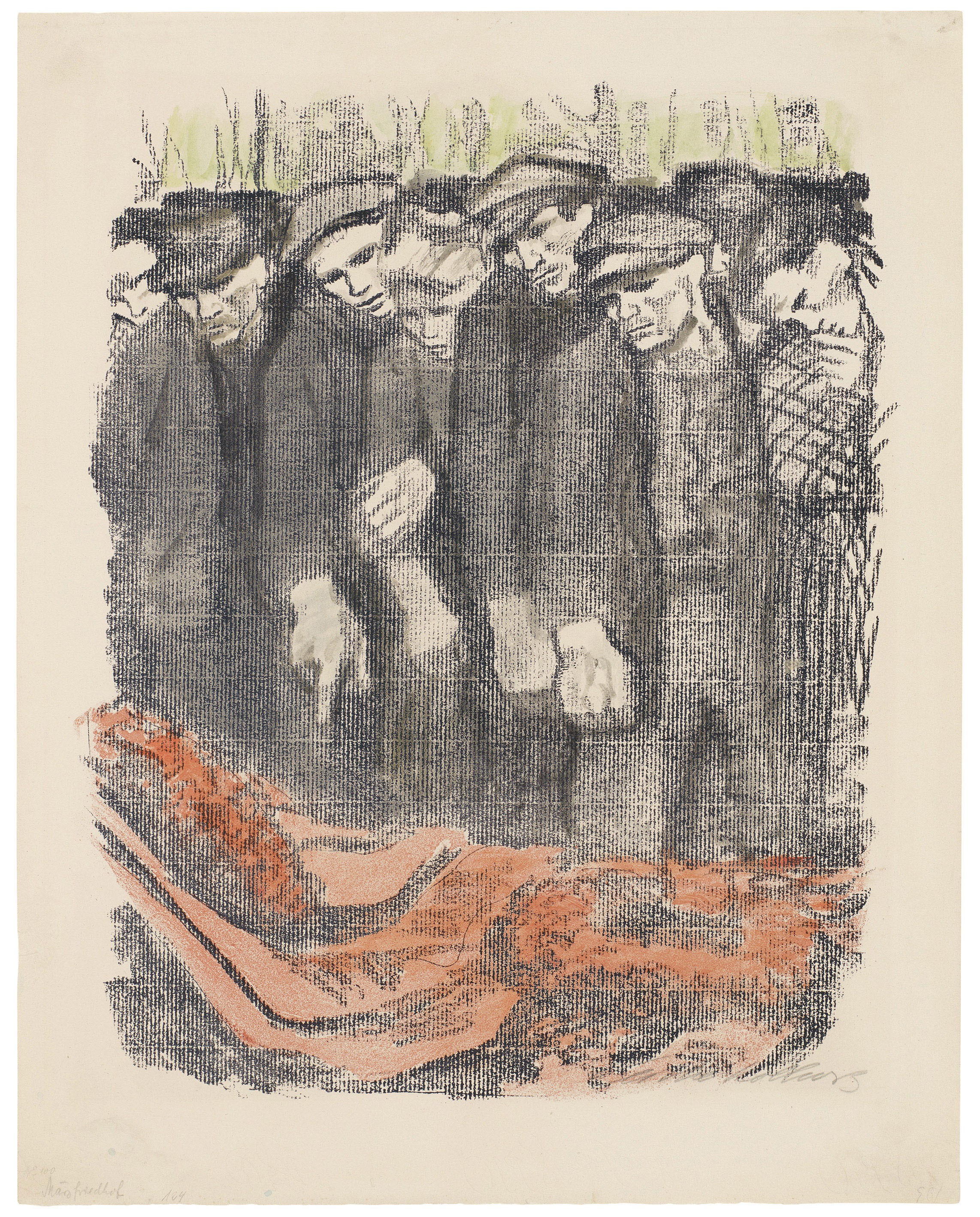
The lithograph »March Cemetery«, Kn 128, was created as a members’ gift of the Freie Volksbühne theatre whose director was Käthe Kollwitz’ brother Konrad Schmidt (1863-1932).
Konrad took his sister to the cemetery for those who fell in the March Revolution in 1848 when she was studying in Berlin. She visited the cemetery regularly after she moved to Berlin.
I visited the March Cemetery of 1848 on the 18th of March every year. A long line of workers slowly walked past the graves from morning till evening. They put wreaths with red ribbons and inscriptions on the tombstones, but many of the ribbons were cut off by the police who stood at the entrance to the cemetery. […] Before the War, the 18th of March was a day that was celebrated by all the red workers in Berlin.«
Johannes Sievers (1880-1969) published the catalogue raisonné of Käthe Kollwitz’ prints.
Johannes Siever’s essential catalogue raisonné, which had been commissioned by the art dealer Emil Richter in late 1910 or early 1911 with the assistant of the director of the Berlin Print Room, was compiled with the assistance of Käthe Kollwitz. It was above all based on the collections of the Berlin and Dresden Print Rooms as well as on the works in possession of the artist herself.
Largest increase in the number of troops since 1871 – by 136,000 to 780,000.
Hugo Haase (1863-1919) and Friedrich Ebert (1871-1925) became party leaders of the SPD after August Bebel’s (1840-1913) death.
Formal opening of the Völkerschlachtdenkmal (Monument to the Battle of the Nations) in Leipzig. As a counter-event, the youth movement celebrated the first Free German Youth Day on the Hoher Meissner mountain.