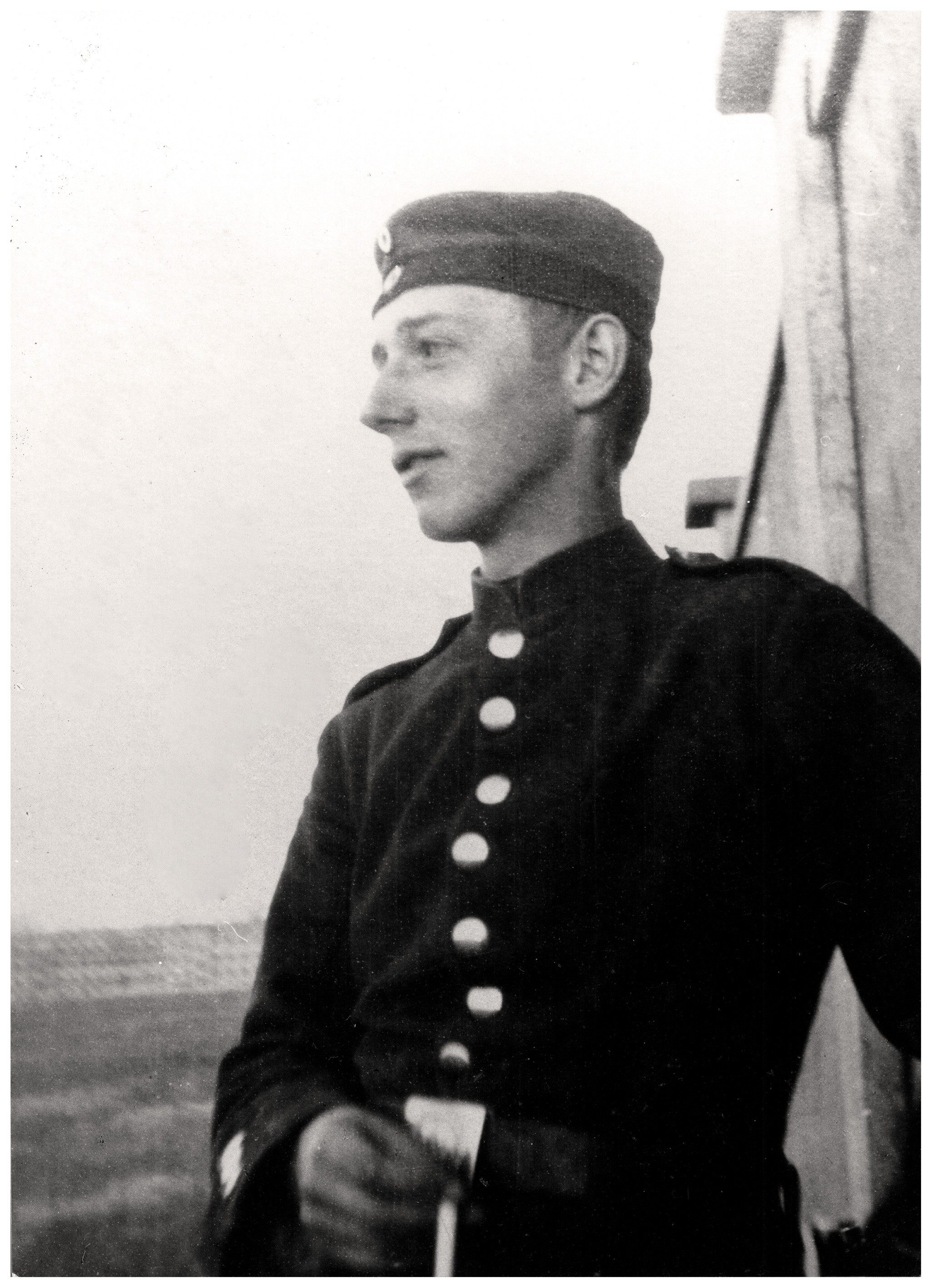
At the beginning of the First World War Käthe Kollwitz briefly joined the Nationalen Frauendienst (National Women’s Service) that defined its task as the equivalent of military service.
Her youngest son, Peter Kollwitz (1896-1914), who was not yet of age at that time, received permission from his father to volunteer for military service.
As a result of her misjudgement of the cause of the war and despite her conflicting feelings, Käthe Kollwitz supported Peter in getting permission from his father.
Peter fell near Dixmuiden in Belgium on 22 October.
Karl argues against this plan as best as he can […]: ›The Fatherland does not need you yet, otherwise they would have drafted you.‹ Peter, quieter, but firm: ›The Fatherland does not yet need young men my age, but it needs me.‹ Again and again he turns around to look at me, silently and imploringly […]. Eventually he says: ›Mother, when you embraced me you said: don’t think I’m a coward, we are ready.‹ I stand up […] and ask Karl to grant Peter his wish. […] He forced this sacrifice on me and we forced it on Karl.«
Her eldest son Hans Kollwitz (1892-1971) served as a medical orderly at the request of his parents. In December he was infected with diphtheria at a convalescent hospital for typhoid sufferers in Spa (Belgium). His father was granted permission to visit him there.
Before her son fell, Käthe Kollwitz drew the lithograph »Waiting«, Kn 132 for the Kriegszeit-Künstlerflugblätter journal published by Paul Cassirer (1871-1926). When Cassirer published the Bildermann journal in 1916 the artist contributed the lithograph »Mother Holding a Child in her Arms«, Kn 136.
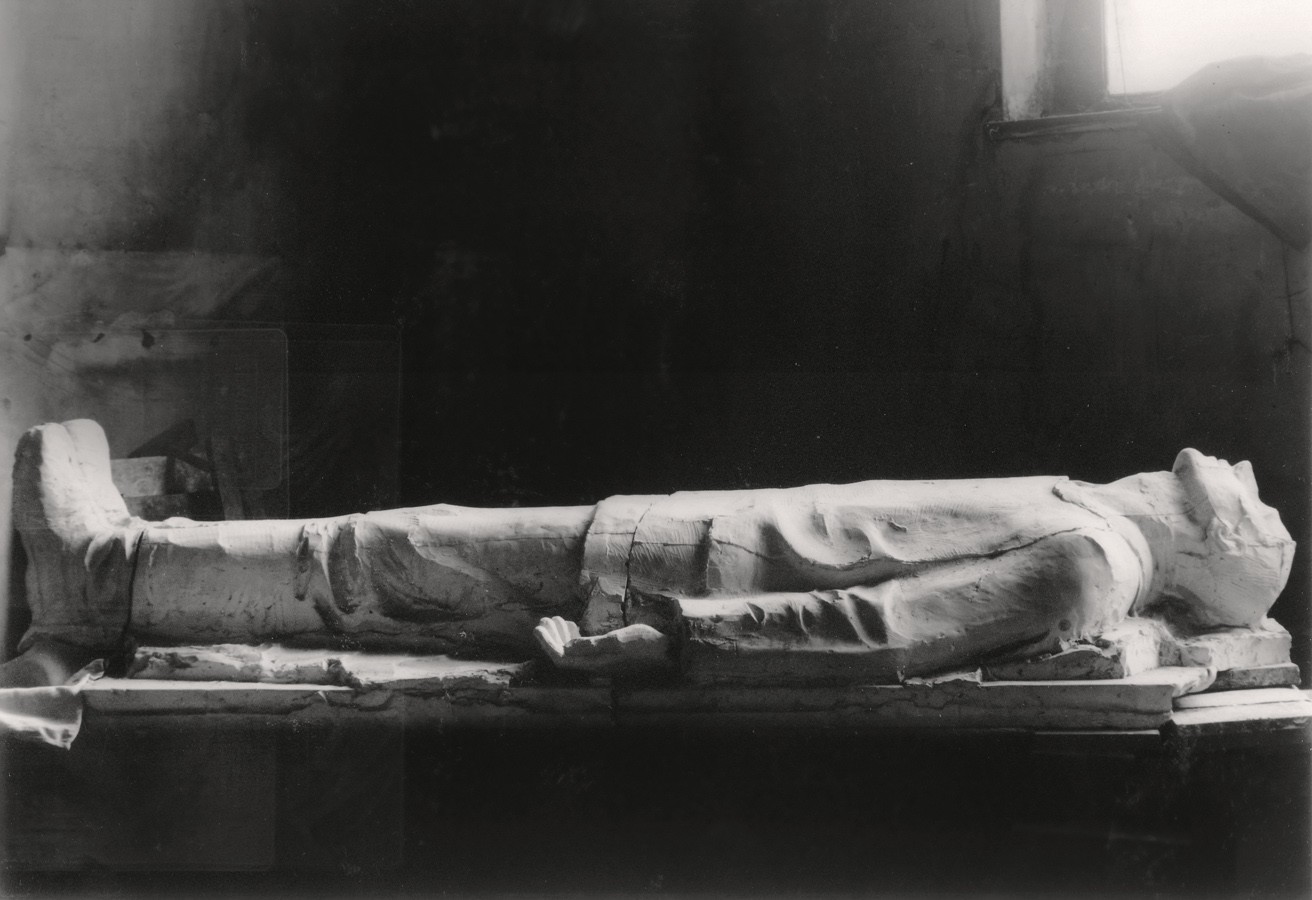
From late 1914 onwards Käthe Kollwitz was imbued with the desire to create a memorial in honour of the sacrificial death of young volunteers – embodied in the figure of her son, with his father at his head and his mother at his feet.
In this work, which was only finished 18 years later in 1932, she eventually abandoned the idea of presenting the fallen soldiers as heroes, and she even gave up the idea of including a portrait of her son. This conceptual change in the design of the memorial reflected her agonising inner change which eventually led to a complete rejection of all wars.
Outbreak of the First World War.
The Austrian successor to the throne, Archduke Franz Ferdinand (1863-1914) was assassinated in Sarajevo on 28 June 1914 by a Serbian underground organisation that was alleged to have links to official bodies. As a result, the Austro-Hungarian Empire declared war against Serbia on 28 July. On 1 August, after Russian mobilisation, the German Kaiserreich, an ally of Austria, declared war against Russia as Serbia’s ally. Two days later the Reich mad a declaration of war against France.
The SPD supported the strategy of the government which suggested to the public that the German Reich was involved in a defensive war against Russia. Karl Liebknecht (1871-1919) was the only SPD member of parliament to vote against war bonds in December.
On the western front, after a brief period of military success, a trench warfare emerged that was to last four years. The Battle of Verdun in 1916 came to epitomise the cruelty of war, and millions of soldiers died as cannon fodder in several unsuccessful offensives. The material and equipment used included modern developments such as poison gas and airships.
The year 1915 was dominated by her mourning for her youngest son Peter Kollwitz (1896-1914) who fell near Dixmuiden on 22 October 1914.
As the grave of their son was in Belgium, which was a war zone, his room at his parent’s house became a place of mourning for his parents, family and friends. Käthe Kollwitz became an attachment figure for Peter’s closest friends, even let them call her ›Mother‹ and expressed great sympathy for them. Like Peter, most of them would fall in the course of the war.
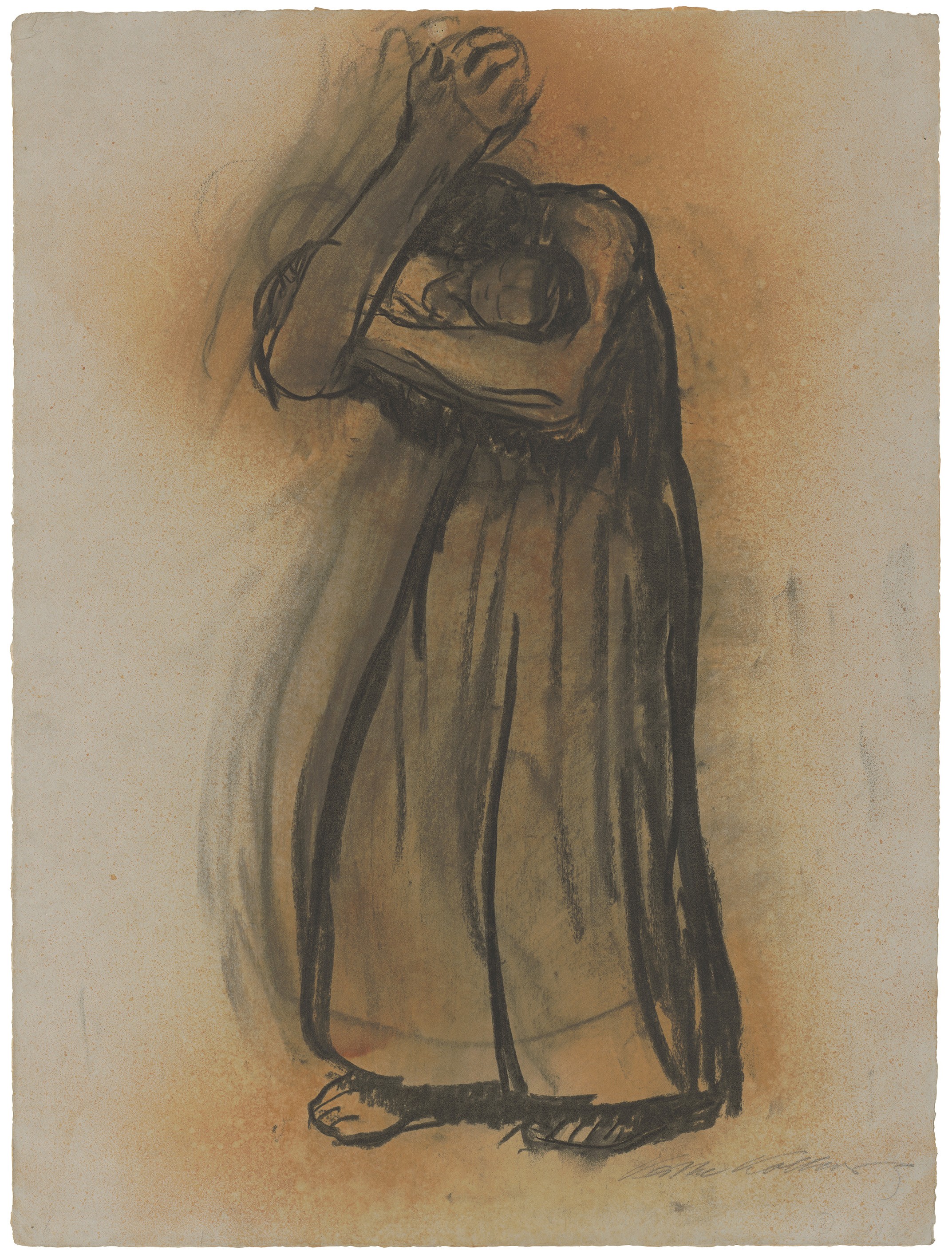
Käthe Kollwitz used her art to come to terms with her grief – as in the expressive charcoal drawing »The Sacrifice«, NT 722.
I am working on the presentation. I ‘had to’ change everything – it was almost compulsive. The figure bent forward under my hands – as if it had a will of its own. Now she is no longer upright. She bends down, very low, offering her child. In deepest humility.”
The artist looked for support for her memorial project for Peter and all the war volunteers, took advice and started work on the sculpture.
The planned three-figure, larger-than-life memorial with the figure of the son between his father and mother was to be erected on the Havelhöhen on a spit of land called Schildhorn in the Grunewald woodlands, a favourite weekend destination for Berliners.
On 22 April German troops employed poison gas for the first time in the Battle of Ypres.
On 19 June high-ranking SPD politicians demanded that their party abandon the political truce.
Britain established a naval blockade to prevent ordnance for the Central Powers of Germany and Austria. This starvation blockade led to a perilous shortage of raw materials and food.
Celebration of Käthe and Karl Kollwitz’ silver wedding.
There was never a lack of love in you and that has made it possible for us to stand so close together after 25 years […] Our marriage tree has grown slowly, not as straight and without obstacles as many others […]. Yet the small sapling has grown into a tree which is healthy at heart.”
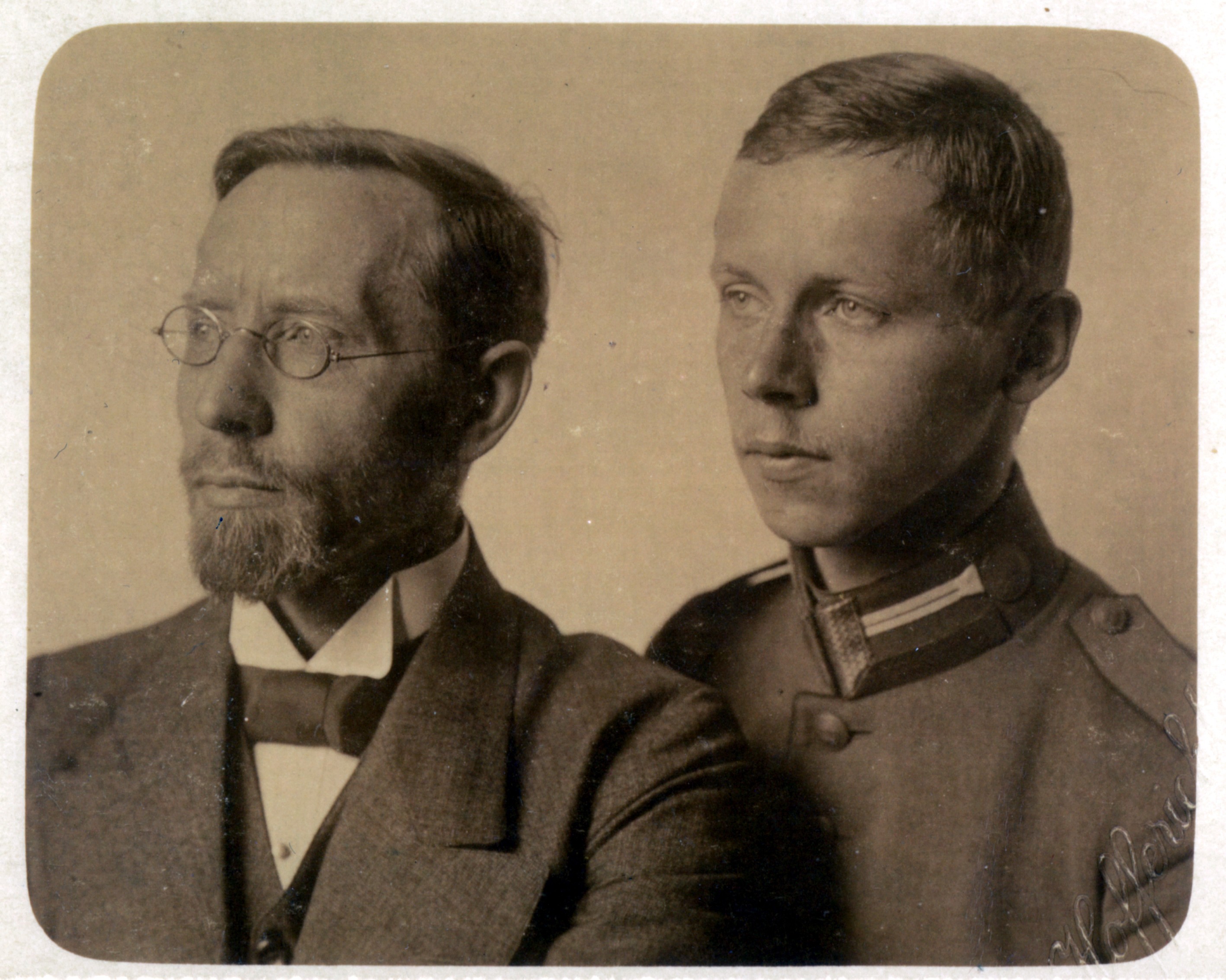
Her eldest son Hans Kollwitz (1892-1971) was deployed to a military reconnaissance unit with moored balloons in Romania.
Käthe Kollwitz became increasingly critical of the sense of the war. Her diary entries bear witness to this gradual, painful inner change that turned her into a pacifist. This transition culminated in 1918 in her public resistance to the war.
Peter, […] they all devoted their lives to the idea of patriotism. The young men in England, Russia and France did the same. The result was a raging battle against each other, which impoverished Europe and robbed it of its most beautiful people. Has the youth in all these countries been deceived? Has their ability to commit themselves been exploited to generate the war? And where are the culprits? Are there any? Have we all been deceived? Has this been a case of mass-madness? And when and how will the awakening be?«
During the so-called Turnip Winter of 1916/17 the food parcels sent by their son Hans were a great help.
Lina’s [Lina Mäkler, maid of the Kollwitz family] voice was trembling as she took the bag of flour [from your parcel]. You can’t imagine how important these things are – flour, beans, oil, bread, peas, in short all the delicious things your parcel contained […] We have stopped going to the soup kitchens because the quality got worse and worse. I’m not sure, though, if we will manage to do without them.«
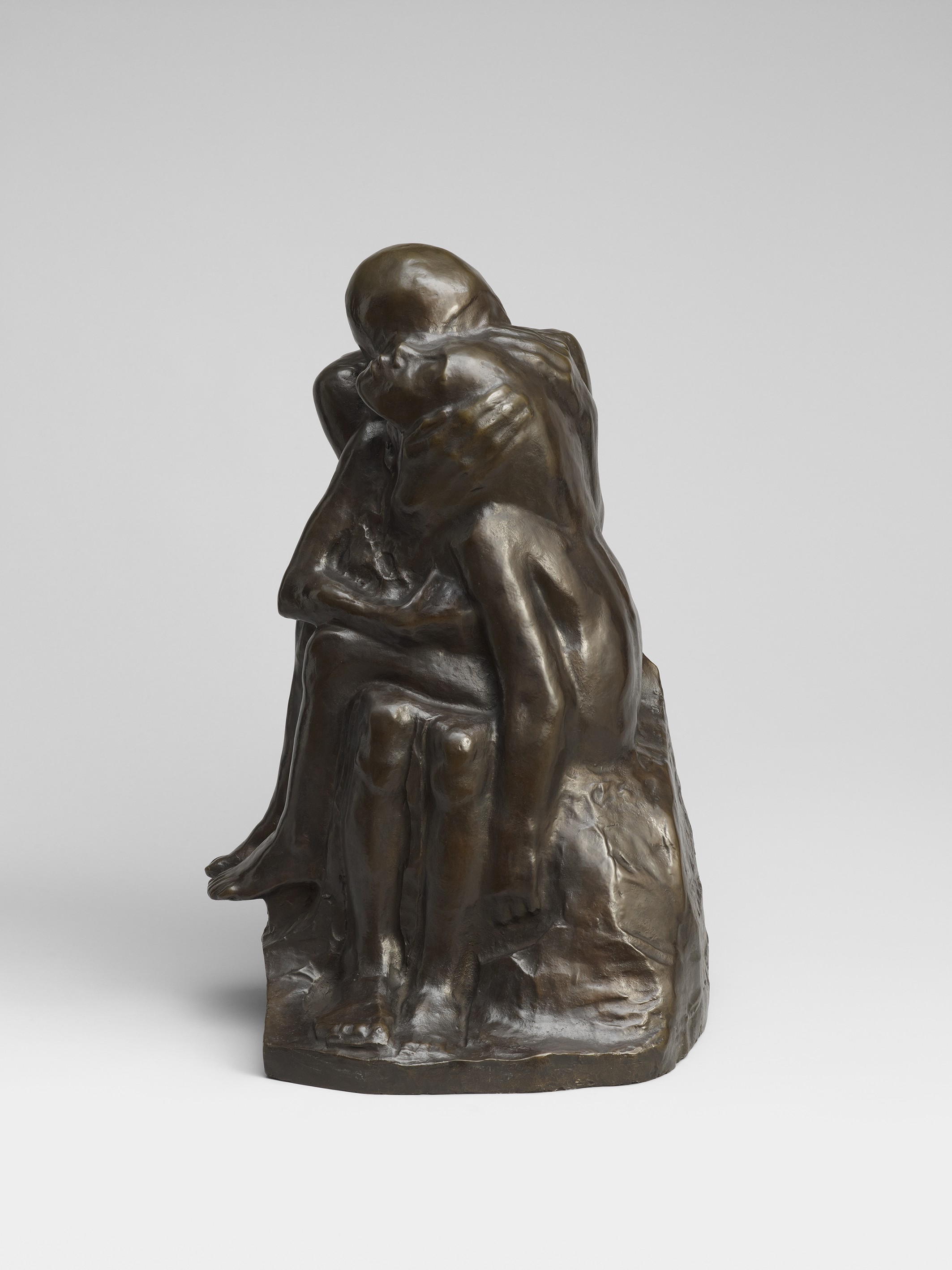
The artist presented her very first sculptural work, the »Group of Lovers«, S 13, at the spring exhibition of the Free Secession.
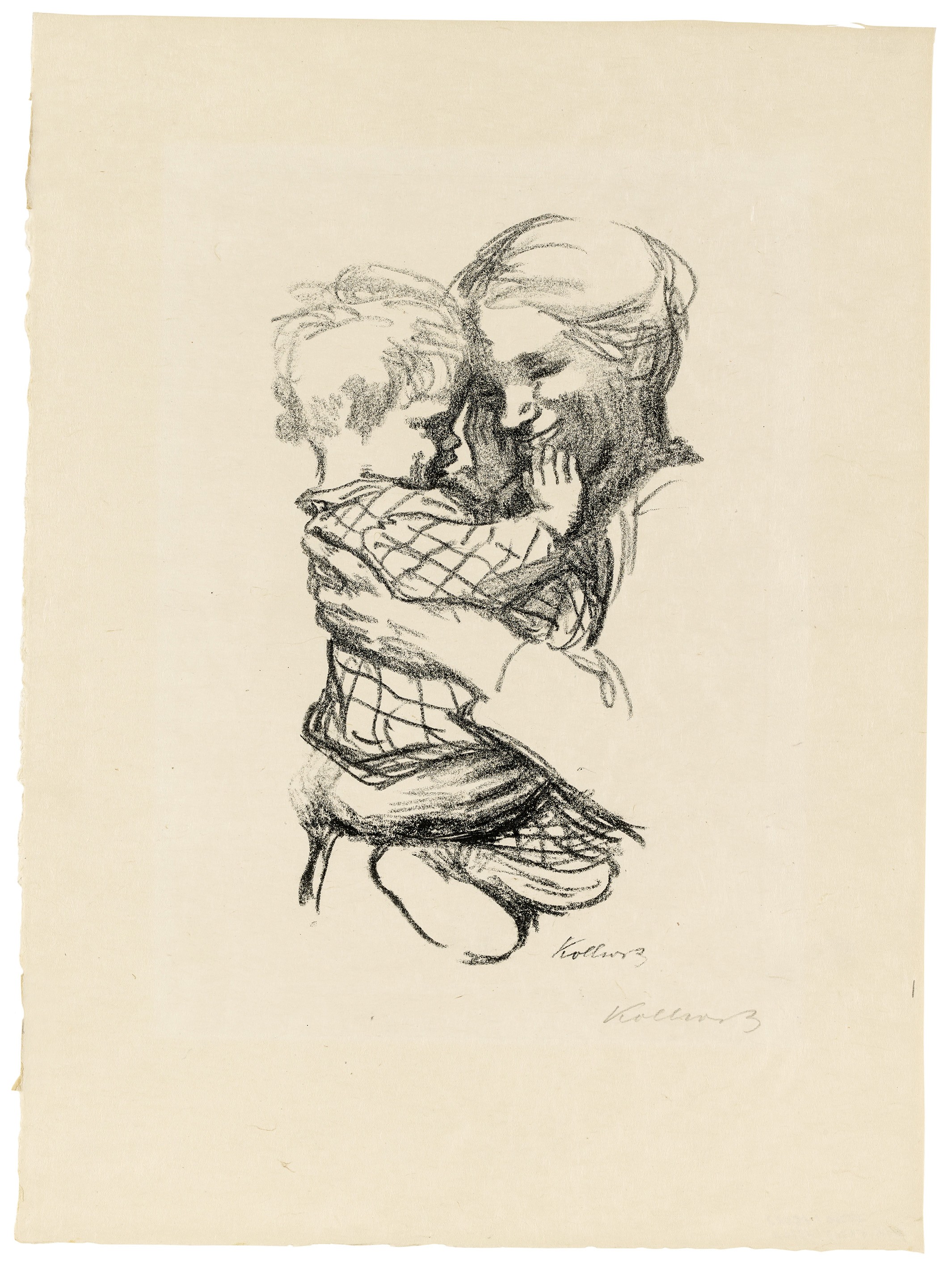
The Bildermann magazine, published by Paul Cassirer (1871-1926), printed the lithograph »Mother with a Child in her Arms«, Kn 136.
The Bildermann magazine replaced Cassirer’s Kriegszeit magazine in 1916 and contained, like the latter, original lithographs by numerous well-known artist and emphasised its pacifist stance. This was in line with the increasing war-weariness of the population.
The SPD politician Karl Liebknecht (1871-1919) was accused of high treason after his anti-war speech on 1 May 1916 and sentenced to 4 years and 1 month in prison. This resulted in a protest strike, the so-called Liebknechtstreik, which was largely limited to Berlin.
The food supply, above all in urban areas, became increasingly problematical after the catastrophic potato harvest in 1916 and dramatically exacerbated the difficulties that had already emerged in 1915. During the Turnip Winter, yellow turnips and swedes, usually regarded as pig feed, replaced bread and potatoes. The health situation of urban residents deteriorated rapidly. The town council of Berlin established soup kitchens to provide food for its population.
The painter Franz Marc (1880-1916) fell in Verdun, France, on 4 March. The Munich Secession organised an exhibition in his honour.
Death of the women’s rights activist Lilly Braun (1865-1916) on 8 August.
Celebration of Käthe Kollwitz’ birthday on 8 July.
Woldemar von Seidlitz (1850-1922), lecturer and councillor at the Royal Art Collection in Dresden, took the opportunity of her birthday to suggest Käthe Kollwitz for admission to the Prussian Academy of Art in Berlin.
Death of her eldest sister Julie Hofferichter (1860-1917).
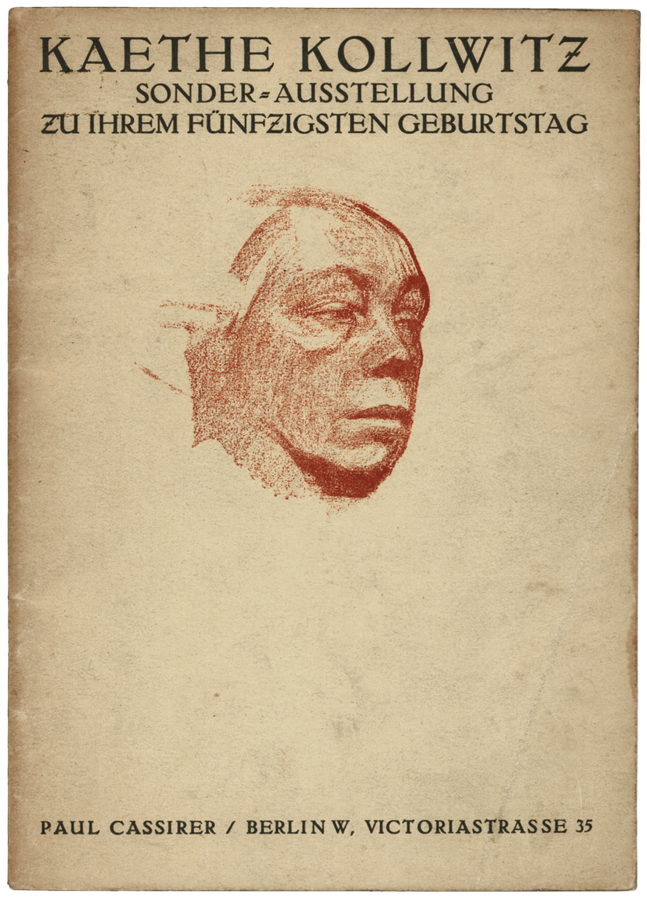
There were numerous exhibitions in her ›jubilee‹ year. The Berlin Print Room presented almost the entire graphic work of the artist.
At the Paul Cassirer (1871-1923) Gallery, Käthe Kollwitz exhibited for the first time a substantial number of drawings. This exhibition subsequently travelled to Königsberg, Dresden, Hamburg and Mannheim.
The exhibition [at Cassirer’s gallery] was a great success. I have heard from many sides that it is regarded as homogeneous and very impressive. […] If my works manage to preserve this effect – even after decades – I have achieved quite a lot. It would mean that I have enriched people’s lives. I assisted with the setting up of the exhibition. Everybody is involved, by the way, but I thought it should fall to me more than anybody else.«
After several SPD members of parliament had vehemently opposed expansionist war objectives in 1916, they were expelled from the party in 1917. As a result of these internal conflicts the party split into MSPD (Majority Social Democrats) under Friedrich Ebert (1871-1925) and USPD (independent Social Democrats) under Hugo Haase (1863-1919). The Spartakusbund joined the latter political grouping. Their most famous members were Rosa Luxemburg (1871-1919) and Karl Liebknecht (1871-1919).
The Aprilstreik (Strike of April) of 1917 was, after the Liebknechtstreik in 1916, the second mass rally in Germany during the World War. As a protest against the insufficient food supply, the so-called Brotstreik (bread strike) directly followed the food riots during the Turnip Winter of 1916/17.
The February Revolution in Russia ended the rule of the Tsars. Vladimir Ilyich Lenin (1870-1924) achieved his aim to establish the Soviet Republic in the November Revolution.
Käthe Kollwitz wrote an open letter against Richard Dehmel’s (1863-1920) Appeal for a final push to win the war. The letter was published on 28 October in the Vorwärts and on 30 October in the Vossische Zeitung.
I herewith express my opposition to Richard Dehmel. I assume, like Dehmel himself, that such an appeal to patriotic honour would be followed by a selected group of young men. Rather like in autumn 1914, where this group consisted mainly of young German men. […]. The result would in all probability be that those who are prepared to sacrifice themselves would indeed be killed. And it would mean that Germany – after the last four years of daily bloodshed – would have haemorrhaged to death. […] In my opinion such a loss would be much worse and more irreparable than the loss of entire provinces. […] We have learned to see things differently during these years. And seems to me that this includes looking at the meaning of the term ›honour‹. […]
Enough people have died! No more people must fall! I invoke a greater poet than Richard Dehmel who said: ›Seeds for sowing must not be ground‹.
When the Social Democrat Philipp Scheidemann (1865-1939) proclaimed the republic from a balcony of the Reichstag (parliament building) during the November Revolution on 9 November, Käthe Kollwitz was among the crowd.
On 17 November, the Vorwärts magazine published an appeal by the artist to give the returning troops a dignified welcome in Berlin. This appeal led to a variety of individuals and institutions concerning themselves with this issue and to Berlin being officially decked with flags for this occasion on 1 December.
On 20 November her eldest son Hans Kollwitz (1892-1971) returned from the war.
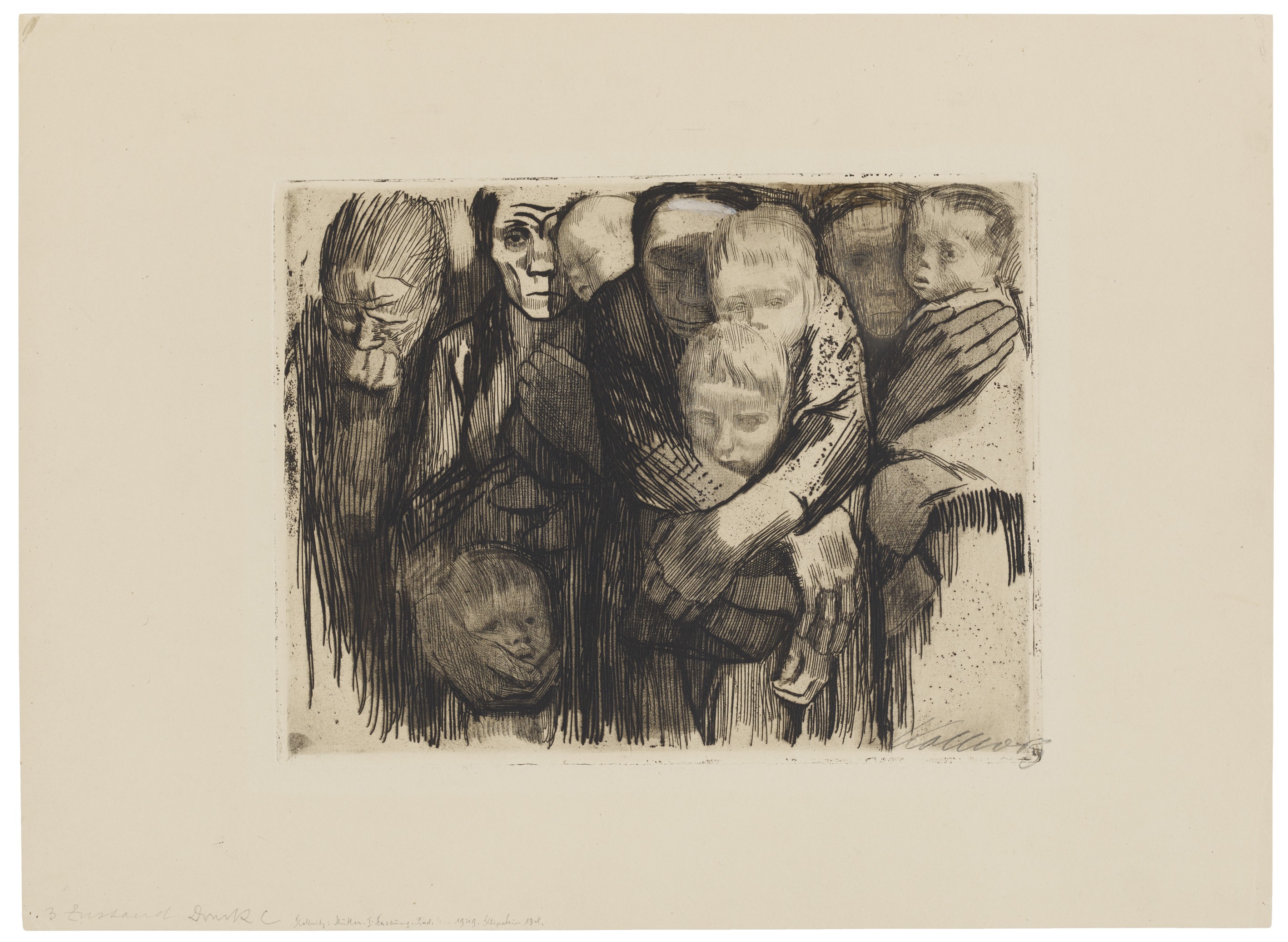
Käthe Kollwitz began work on her print series »War« (1918-1922/23). She had initially planned the cycle in the last year of the war as a series of etchings, but reworked it as a lithograph cycle in 1919/20 and eventually executed it as a woodcut series in 1921-1922/23.
I have now […] immersed myself in a work which I probably had vague ideas about since 1914. […] So far, there are only drawings. Never showed them to anybody. Cried when I drew them. Apart from the fact that I had not considered doing any graphic works in the next few years, there were two other reasons why I kept procrastinating. First of all, it is the apprehension about letting the deeply experienced feelings from these years out into the open […]. And then it is the feeling of the bumbling inadequacy of the studio work […] to express all this living and dying.«
During the January Strikes, more than a million workers demanded better living and working conditions, an end of the First World War and the democratisation of the constitution of the German Reich.
After negotiations lasting several months, the Peace Treaty of Brest-Litovsk was singed on 3 March between Soviet Russia and the Central Powers of Germany and Austria.
The November Revolution on 9 November led to the abdication of Kaiser Wilhelm II. The Social Democrat Philipp Scheidemann (1865-1939) proclaimed the republic.
The Truce of Compiègne of 11 November ended military action between Germany and the two Western Powers, France and Britain. The First World War had claimed the lives of 10 million people and the number of wounded was 20 million.