
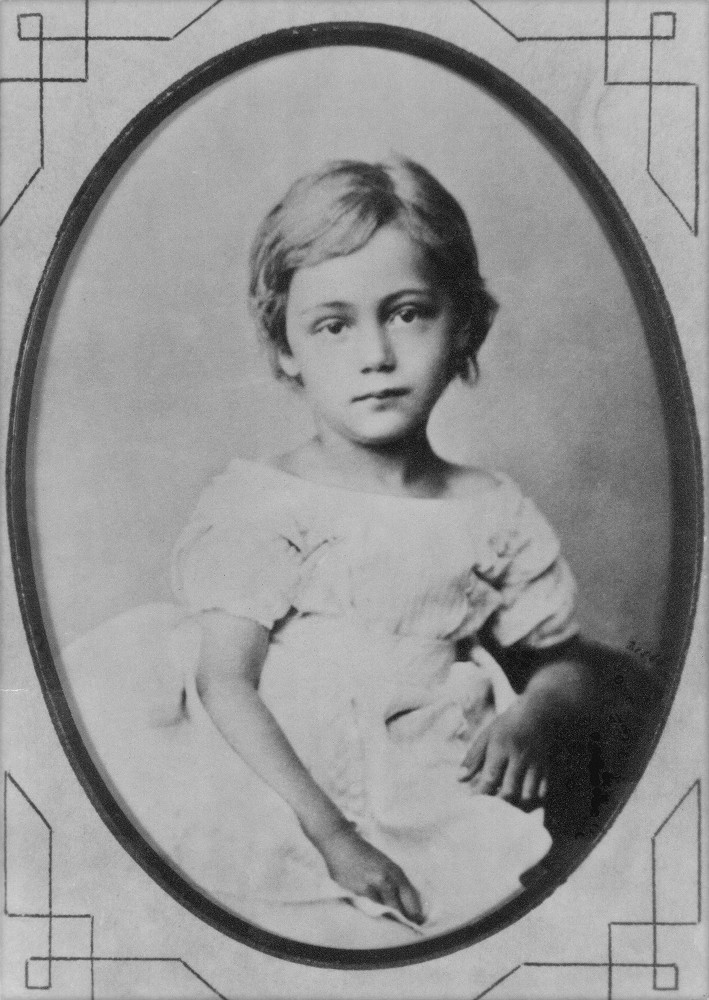
Käthe Kollwitz, née Schmidt, was born on 8 July 1867 in Königsberg (present-day Kaliningrad), East Prussia, as the fifth child of Carl Schmidt (1825-1898) and Katharina Schmidt, née Rupp (1837-1925).
Her personal development was decisively influenced by her father, her brother Konrad Schmidt (1863–1932), and the members of the Freie evangelische Gemeinde (Free Evangelical Community) in Königsberg, which had been founded by her maternal grandfather, Julius Rupp (1809–1884).
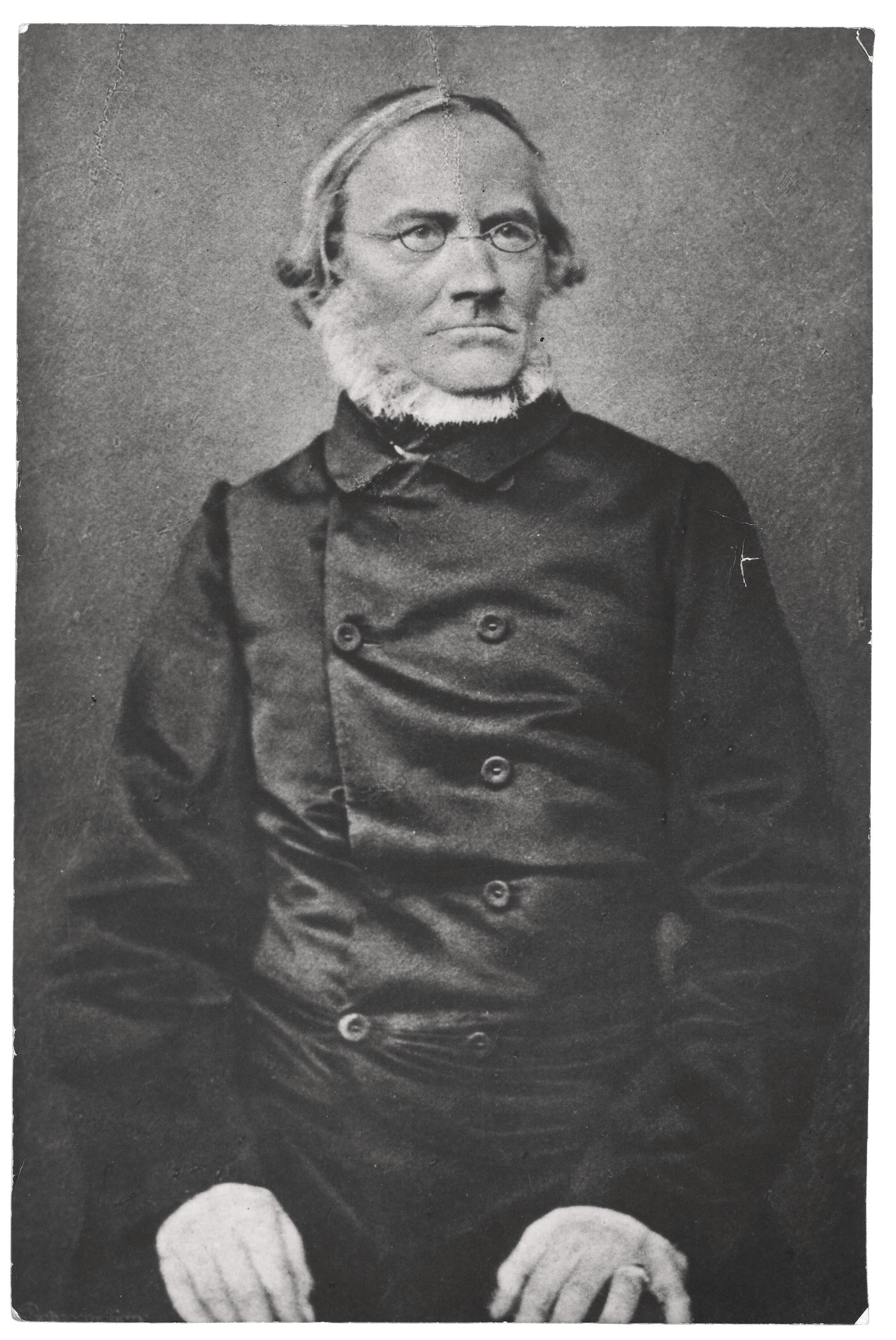
Her grandfather, a politically liberal theologian, teacher and divisional chaplain, was an advocate for freedom of teaching and freedom of conscience and rejected the church’s dependency on the state and any coercion linked to faith and symbols. As a result, he lost his official positions in 1845 and in 1846 he founded the first German Freie evangelische Gemeinde (Free Evangelical Community) in Königsberg where all members, including women, had a voting right. No official creed was established as Rupp advocated unconditional freedom of conscience and free ethical-religious self-determination of the individual, which included the pursuit of self-awareness and truth.
In 1848 Julius Rupp gave a speech in honour of those killed in the March Revolution, which attracted nationwide attention. In 1849 he was an independent member of the Prussian parliament and in 1862/63 he represented the Fortschrittspartei (Progressive Party) in parliament.
Although I think I know that I lacked my grandfather’s religious strength, what stayed with me was a feeling of reverence for his teaching, his personality and the community he created. I would say that I, being their descendant, felt in me […] the presence of both my grandfather and my father. My father was closest to me as he guided me towards Socialism – in the sense of longing for a brotherhood of men. But behind this was Rupp, the person with the connection […] to God. The religious man«.
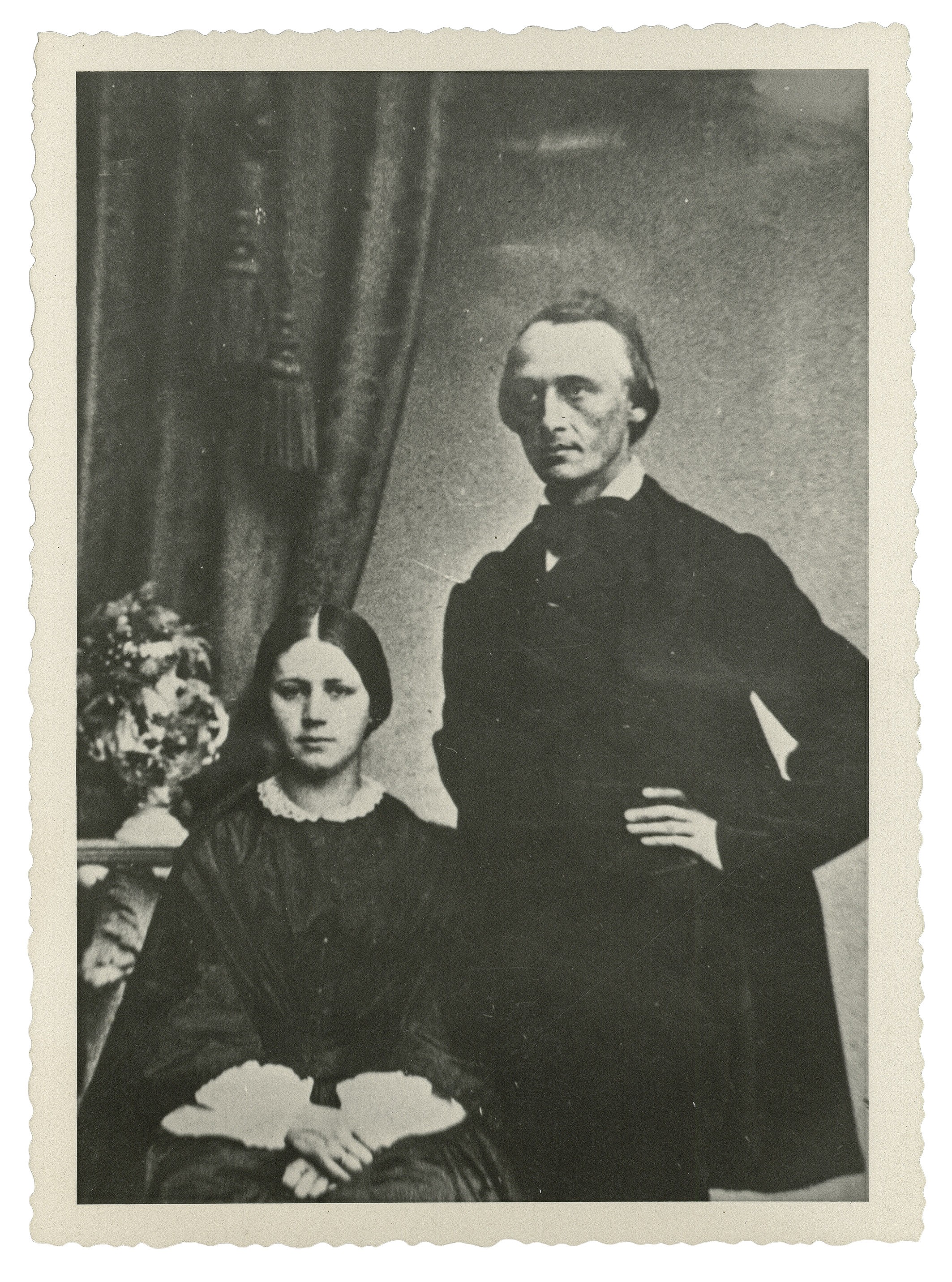
Käthe Kollwitz’ father had republican leanings and studied law. During the Revolution of 1848 he tried to join the Hungarians in their fight for freedom. In 1853 he was forced to abandon his career as a lawyer as a result of his membership of the Freie evangelische Gemeinde (Free Evangelical Community). He subsequently trained as a mason and became a successful building contractor.
In 1860 he married Katharina Rupp (1837-1925), the eldest daughter of Julius Rupp. After Julius’ death in 1884 Carl took over his position as a preacher. In 1887 Carl Schmidt joined the SPD (Social Democratic Party of Germany).
Looking back, Käthe Kollwitz remembered how her father read works by the revolutionary poets of the Vormärz – the age of Metternich – to the children:
My father sometimes read out aloud to us. Once he read (…) ›Die Toten und die Lebenden‹ by Freiligrath. This poem left an indelible impression on me. Street battles – Father and Konrad joining the fight (…), those were heroic fantasies.«
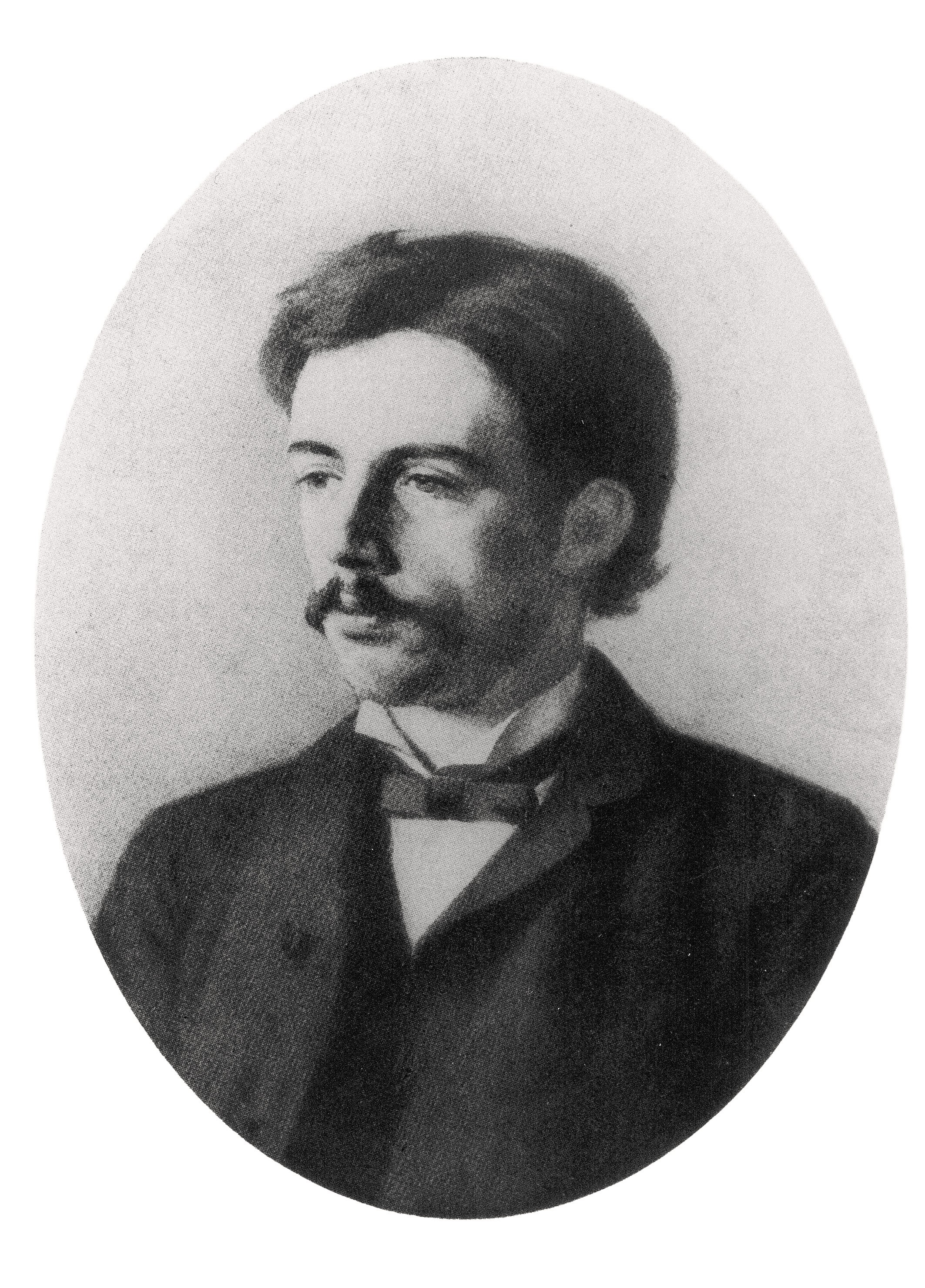
Käthe Kollwitz elder brother studied national economics in Berlin and took his degree at Königsberg University in 1886 with a thesis comparing Johann Karl Rodbertus’ and Karl Marx’ theories on wage and exploitation.
From 1887 he paid several visits to the philosopher, sociologist and entrepreneur Friedrich Engels (1820-1895). The two men started a frequent exchange of letters and Konrad Schmidt, enthusiastic about the ideas of the international and German workers’ movement, joined the SPD.
Being a socialist and dissident, Konrad Schmidt was initially unable to pursue a career at the university. It was only from 1890 that he worked as a private lecturer at the University of Zurich and as an editor of the economics section at the Züricher Post. From 1895 he worked sporadically for the social-democratic weekly Vorwärts, and from 1908 for the monthly journal Sozialistische Monatshefte. He unsuccessfully stood as a candidate for the Reichstag in 1898. In 1919 he was appointed professor of national economics at the Berlin Polytechnic.
Konrad Schmidt was an enthusiastic supporter of Naturalism in literature and in 1897 he took over the directorship at the Berlin Freie Volksbühne theatre which he had co-founded in 1890. The aim of this theatre association – independent of the board of censors – was to give the proletariat access to the theatre and not to be exclusively dominated by aesthetic aspects when staging a play.
[Konrad] had a profound influence on me – particularly during my developmental period – and affected my choice of reading matter.«
Otto von Bismarck (1815-1898) was the first to be appointed chancellor of the Norddeutscher Bund (North German Confederation), founded in 1866.
Five years later, on 18 January 1871, Wilhelm I of Prussia (1797-1888) was acclaimed German Kaiser in the Hall of Mirrors at Versailles. Thus the first German nation-state under Prussian leadership was created and comprised the Norddeutscher Bund and four south German states. Otto von Bismarck became the first chancellor of the German Reich.
After the revolution in 1848, women’s rights had become very limited and non-governmental organisations were established. In 1867 the Verein Berliner Künstlerinnen und Kunstfreundinnen (Association of Women artists and art lovers) was founded as the oldest and most renowned professional organisation for women artists in German-speaking countries. A year later, this association opened the first painting and drawing school for women in Berlin.
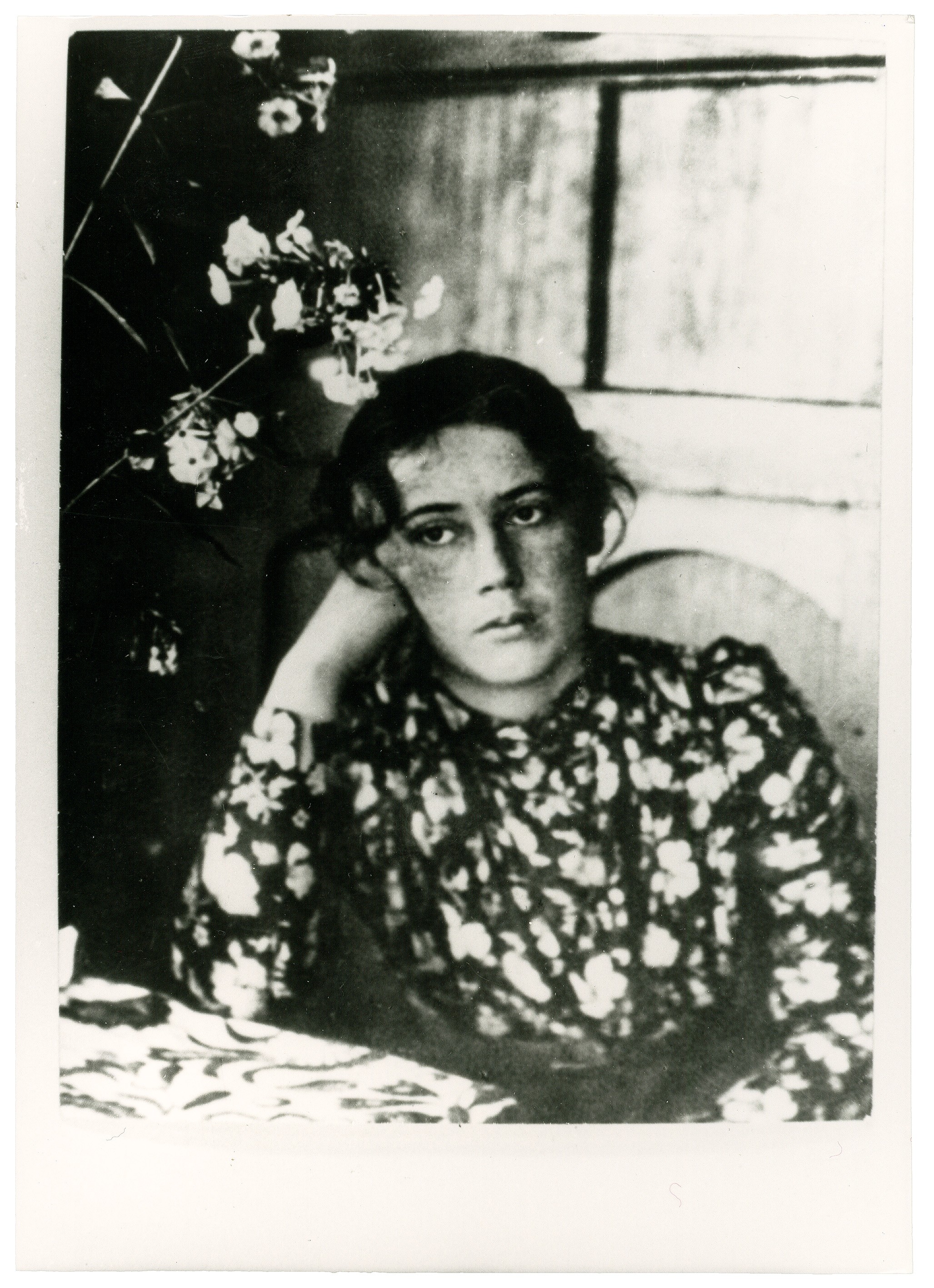
Birth of Lisbeth Schmidt (1870-1963), Käthe Kollwitz’ sister.
Käthe and Lisbeth had a very close relationship, and as a young woman Lisbeth was frequently the artist’s model. In 1893 Lisbeth married the Jewish engineer Dr Georg Stern (1867-1934) from Königsberg. The couple moved to Berlin, just as Käthe Kollwitz did after her marriage. Her daughters were the physician Regula Stern (1884-1980), Hanna Stern (1896-1988), who later adopted the stage name Johanna Hofer, and the actresses Katharina Stern (1897-1984) and Maria Matray (1907-1993).
Lisbeth wrote for the arts section of the Sozialistische Monatshefte where her eulogy on the 50th birthday of Käthe Kollwitz was published in 1917. She wrote two other insightful articles on her sister – in 1920 for the Freie Welt and in 1927, on the occasion of the artist’s 60th birthday, for the Vorwärts.
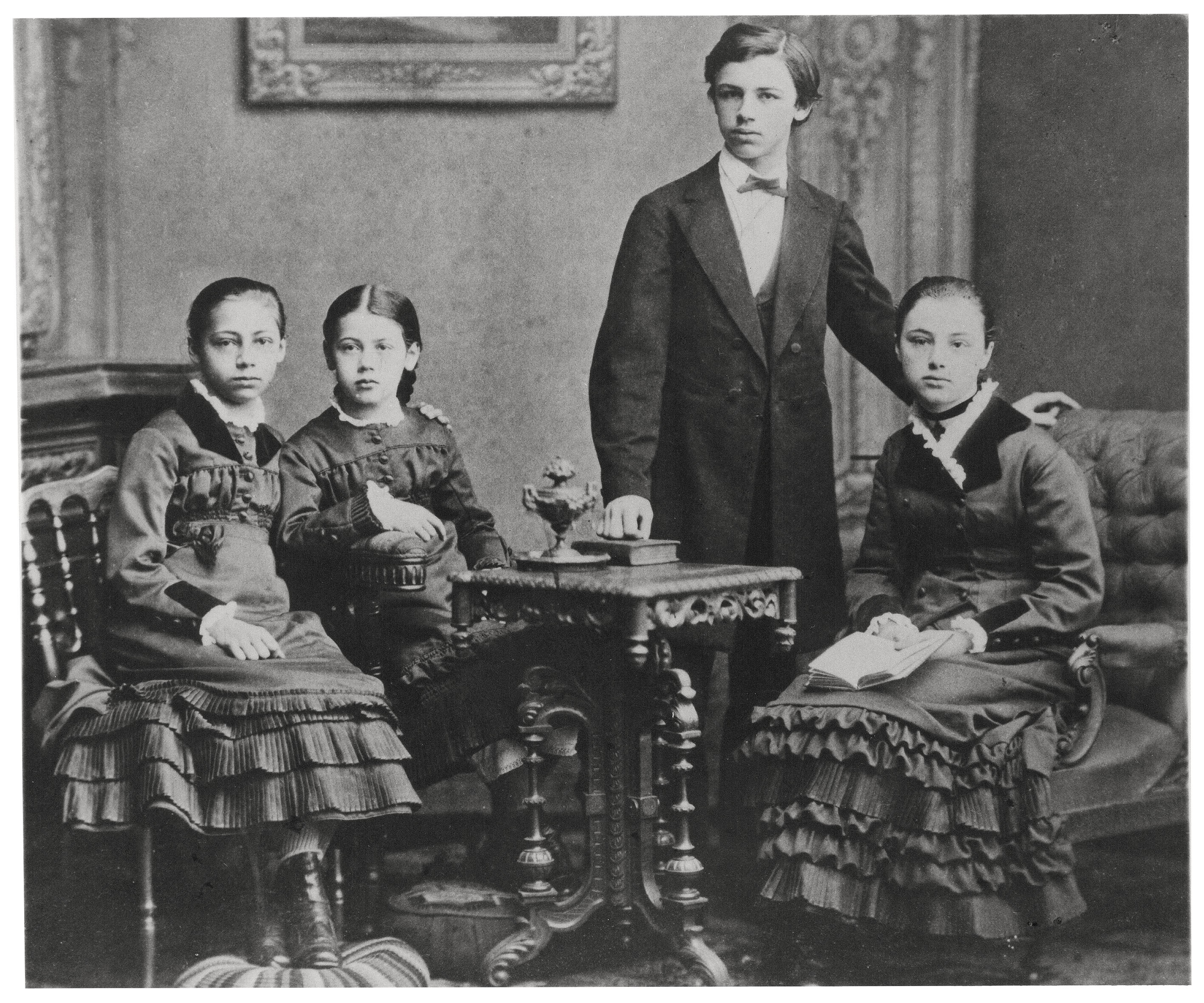
In the second half of the 1870s Carl Schmidt (1825-1898), Käthe’s father, converted his building firm into a cooperative society. Soon afterwards he sold the company and the family moved into a flat in the upmarket Königsstrasse in Königsberg.
In the summer holidays, the family spent time at the seaside resort of Rauschen on the Baltic Sea.
At a party convention in Gotha (22-27 May), the Sozialdemokratische Arbeiterpartei (SDAP) and the Allgemeiner Deutscher Arbeiterverein (ADAV) merged to form the Sozialistische Arbeiterpartei (SAP).
The history painter Anton von Werner (1843-1915), the artist favoured by Wilhelm II, was appointed director of the Academy of Fine Arts – the so-called Berliner Akademie. Von Werner rejected modern styles such as Naturalism and Impressionism.
Adolph von Menzel (1815-1905) finished his painting »Iron Mill« – the first German large-scale depiction of industrial life.
Kollwitz’ youngest brother Benjamin Schmidt died of meningitis.
In this house [the flat in Königsstrasse] my mother gave painful birth to her last, much loved child who was given the name of Benjamin, according to my father’s wish. This child also only lived for one year and died of meningitis, like the oldest child. This time has left a very strong impression on me. […] When he [her grandfather Julius Rupp] emerged [from the room] he approached Konrad and said something very serious to him. In my memories his words were something like ›You see how transitory everything is?‹ […] This is my first conscious memory of him.«
Assassination attempt on Kaiser Wilhelm I (1897-1888).
Bismarck used the assassination attempt to dissolve parliament and enforce a law Against the socially dangerous ambitions of Social Democracy. This Sozialistengesetz came into effect in 1878 and its objective was to eradicate Social Democracy, and until 1890 social democratic, socialist and communist associations, meetings and printed publications were made a punishable offence. Individuals were, however, still allowed to stand for the SPD in the Reichstag and regional parliaments.
Käthe Kollwitz had her first lessons in drawing. Her teacher was the copperplate engraver Rudolf Mauer (1845-1905) who taught beginners’ classes for free-hand drawing and evening classes for drawing after plaster casts at the Königsberg Academy. Later, Käthe Kollwitz had additional lessons with the painter Friedrich Naujok (no reliable biographical data).
Her training as an artist was the result of her father’s commitment.
Sadly, I was a girl, but he [her father] was still determined. As I was not a very attractive girl, he thought that love matters would not thwart my career. […] My first lessons were with the copperplate engraver Mauer. There were one or two other girls in his class, I think. We drew heads after plaster casts and models.«
Käthe Kollwitz and her sisters were given great freedom by their parents compared with other middle-class girls of that time. They had free access to the family’s library and Käthe read Schiller and Goethe. She held the latter in high esteem all her life.
In the afternoon, she and her younger sister Lisbeth (1870-1963) strolled through Königsberg and the city’s docklands. These rambles laid the foundation stone for her later artistic exploration of the world of the working classes.
We strolled through the entire city, left the gates, took a ferry across the Pregel and explored the harbour. Then we stood and watched the bag carriers, the loading and unloading of the ships. […] We knew where the grain ships were anchored, with the sailors on deck wearing sheepskin coats and rags wrapped around their feet. They were Russians or Lithuanians – good-natured people. In the evening they played the accordion on their flat boats and danced to the music. […] These rambles through the dense port city with its many workers are the reason why my later works were entirely inspired by the world of workers for a time.«
The first public telephone exchange was opened in Berlin. It had 48 connections and was the first local telephone network in Germany.
The worldwide first electric tram was put into service in Lichterfelde near Berlin.
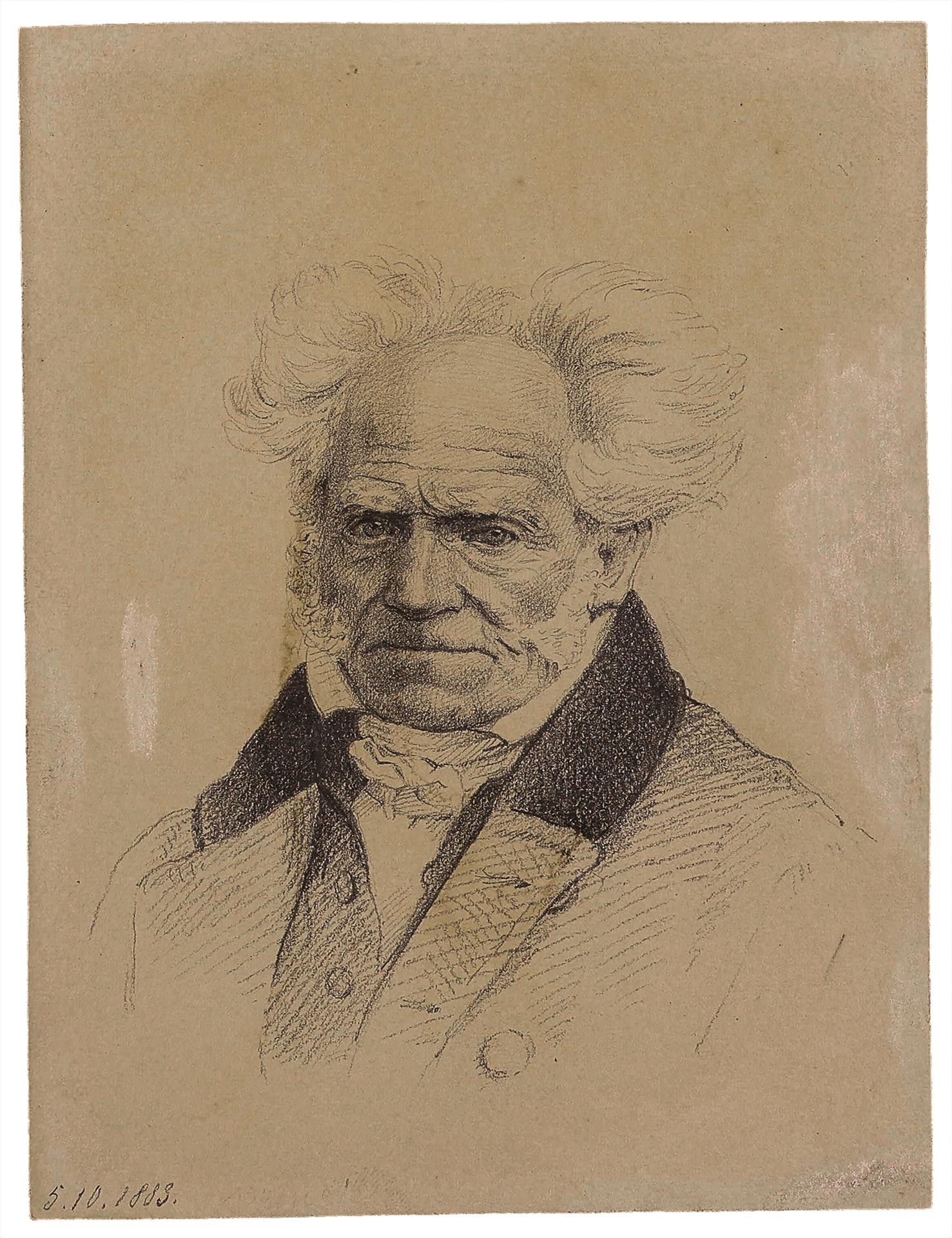
Käthe Kollwitz first extant drawing shows a half-length portrait of the philosopher Arthur Schopenhauer (1788-1860) after a model.
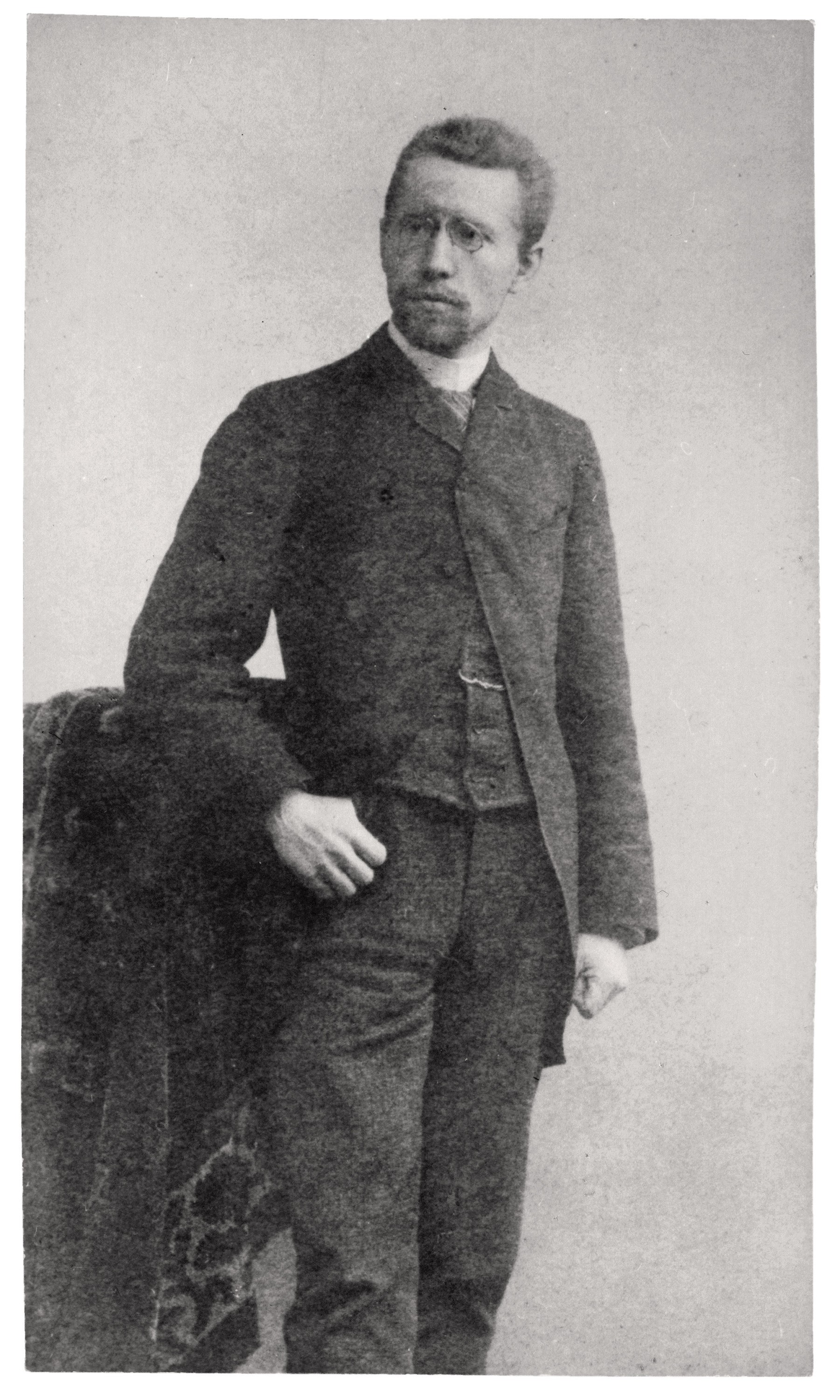
1884 or 1885: Secret engagement of the artist with Karl Kollwitz (1863-1940).
Karl Kollwitz, a medical student, had been friends with Käthe’s brother Konrad Schmidt (1863-1932), since their school days. He was a member of the Freie evangelische Gemeinde.
Karl Kollwitz completed his medical studies at the Albertus Magnus University in Königsberg and obtained his doctorate in medicine. In 1891, after marrying Käthe Kollwitz, he opened a practice as an accredited general practitioner in the Berlin working-class district of Prenzlauer Berg.
In 1913, he co-founded the Social Democratic Association of Physicians and became a member of the Jugendfürsorgeausschuss (Youth Welfare Committee) in the Prenzlauer Berg district. After the November Revolution in 1918 he became an SPD town councillor and was involved in local politics in Berlin.
Creation of the first ›narrative‹ drawings.
Käthe Kollwitz created – among other similar works – a drawing after the painting »Luther burning the bull of excommunication« (1853) by Carl Friedrich Lessing (1808-1880) and a depiction of the working-class world based on the poem »The Emigrants« by Ferdinand Freiligrath (1810-1876), which was romantic in tone rather than using social criticism. None of these early works of the artist have been preserved.
Almost all my early drawings were anecdotal, capturing all manner of things that happened either in reality or in my imagination. So even then there was an element of ›examination of life‹ ...«
Publication of the novel »Germinal« by Emile Zola (1840-1902).
Käthe Kollwitz, her mother Katharina Schmidt (1837-1925) and her sister Lisbeth (1870-1963) travelled to the Engadin via Berlin and Munich.
In Erkner, near Berlin, she met the young Naturalist writer Gerhart Hauptmann (1862-1946).
Hauptmann had made friends with her sister Julie and her husband Paul Hofferichter who lived in that area.
Hauptmann […] was not yet famous and had just written the ›Promethidenlos‹ […] I remember we were sitting in a large room that was festively decorated. There were a few steps leading into the garden. There was Hauptmann himself, his wife, the painter Hugo Ernst Schmidt, Arno Holz and my brother Konrad. It was an evening that had a lasting effect on us. There was a long table strewn with roses in the large room. We all had rose wreaths on our heads and drank wine. Hauptmann read a passage from Julius Caesar [by Shakespeare] We were all entranced, young as we were. It was a wonderful prelude to a life that slowly, but steadily unfolded for me.«
In Munich, another stage on her journey, she visited the Alte Pinakothek. She was particularly fascinated by the works of Peter Paul Rubens (1577-1640). Later, during her time studying at the Munich Art Academy for Women (1886-90), she was to draw the figure of the breastfeeding satyr woman from Rubens’ »Drunken Silenus«.
An then, at the Pinakothek, I saw the works of the masters of whom one made an especially strong impression that was to last for years to come – Rubens. I was entranced by him. And what a treasure of Rubens paintings there were in Munich! […] I had a small volume of Goethe’s works then and when I was completely enraptured I just wrote on the margin: Rubens! Rubens!«
In 1886/87 she attended Karl Stauffer-Bern’s (1857-1891) painting classes at the Berlin Academy for Women Artists.
This Swiss painter, graphic artist and sculptor initially made a name for himself in Berlin as a realist portrait painter when he had finished his studies at the academy. In 1884 his friend Peter Halm introduced him to etching techniques and in 1886 he began to take an interest in sculpting. From 1888 he worked exclusively as a sculptor.
He first introduced Käthe Kollwitz to portrait studies, but soon he had her re-focus on drawing as she still lacked some important basics.
The artist later referred to Karl Stauffer-Bern as »the teacher to whom I perhaps owe everything«:
I only studied with him for one winter, but these few months laid the foundations. I am still grateful that he led me back to drawing again and again when I wanted to do painting.«
At the Berlin Academy of Art of Women Käthe Kollwitz met Beate Jeep (1865-1954) who became a close friend and often gave her advice on many of her works.
In 1895, Beate Jeep marries Arthur Bonus, the one year older priest and writer. The couple had a lifelong friendship with Käthe and Karl Kollwitz.
After Käthe Kollwitz’ death, Beate Bonus-Jeep immortalised their friendship in the book Sechzig Jahre Freundschaft (Sixty years of friendship) with Käthe Kollwitz. The book was published in 1984 by Karl Rauch Verlag.
The Strike Decree of 11 April 1886 by the Prussian minister of the interior, Robert Victor von Puttkamer (1828-1900) acknowledged the right to form coalitions and organise industrial action. Strikes including Social Democratic agitation were, however, classified as political and thus illegal. Thus a stricter application of the Sozialistengesetz was re-introduced in Prussia after its implementation had been somewhat relaxed between 1881 and 1886.
After her return to Berlin, Käthe Kollwitz had lessons in genre and portrait painting with Emil Neide (1843-1908).
Emil Neide was a painter of renown in East Prussia and an Academy professor. He was involved in the decoration of the main lecture hall at Königsberg University and the assembly halls of several grammar schools in Insterburg and Königsberg where he contributed mythological themes and representations from Prussian history.
Käthe Kollwitz’ father had plans to have his daughter trained in history painting, which was regarded as the most sophisticated genre, but was also an exclusively male domain. Käthe Kollwitz, however, rejected conservative Wilhelminian history painting. Her focus of interest was on the exploration and depiction of everyday life. The only work by Emil Neide that she appreciated was the matter-of-fact genre painting »At the Crime Scene« (c. 1886) which shows the discovery of a murder victim’s body.
After my return to Königsberg, the Academy professor Neide became my teacher and eventually I was permitted to paint ›real pictures‹. It was a tedious time and I was seriously fed up with painting. Then my parents intervened in a way for which I’m still extremely grateful – they sent me to Munich for two years.«
The Schmidt family experienced the effects of the Anti-Socialist Laws when the police searched their flat.
Her brother, Konrad Schmidt (1863-1932) had visited Friedrich Engels (1820-1895) in London. A shipment of books from England was found to contain Social Democratic publications which were illegal in Germany. A charge against him was, however, dropped.
Shortly afterwards, Konrad and his father joined the Socialist Workers’ Party (SAP). Käthe Kollwitz could not yet join as membership of a political party was forbidden for women. Since these events, however, she felt connected to the Social Democratic movement and later she referred to her father as the person who had guided her towards Socialism.
Her fiancé, Karl Kollwitz (1863-1940), was also a Social Democrat.
The inventor Emil Berliner (1851-1929) took out a patent for the gramophone.
In July, Käthe’s parents publicly announced the engagement of their daughter to the prospective physician Karl Kollwitz (1863-1940).
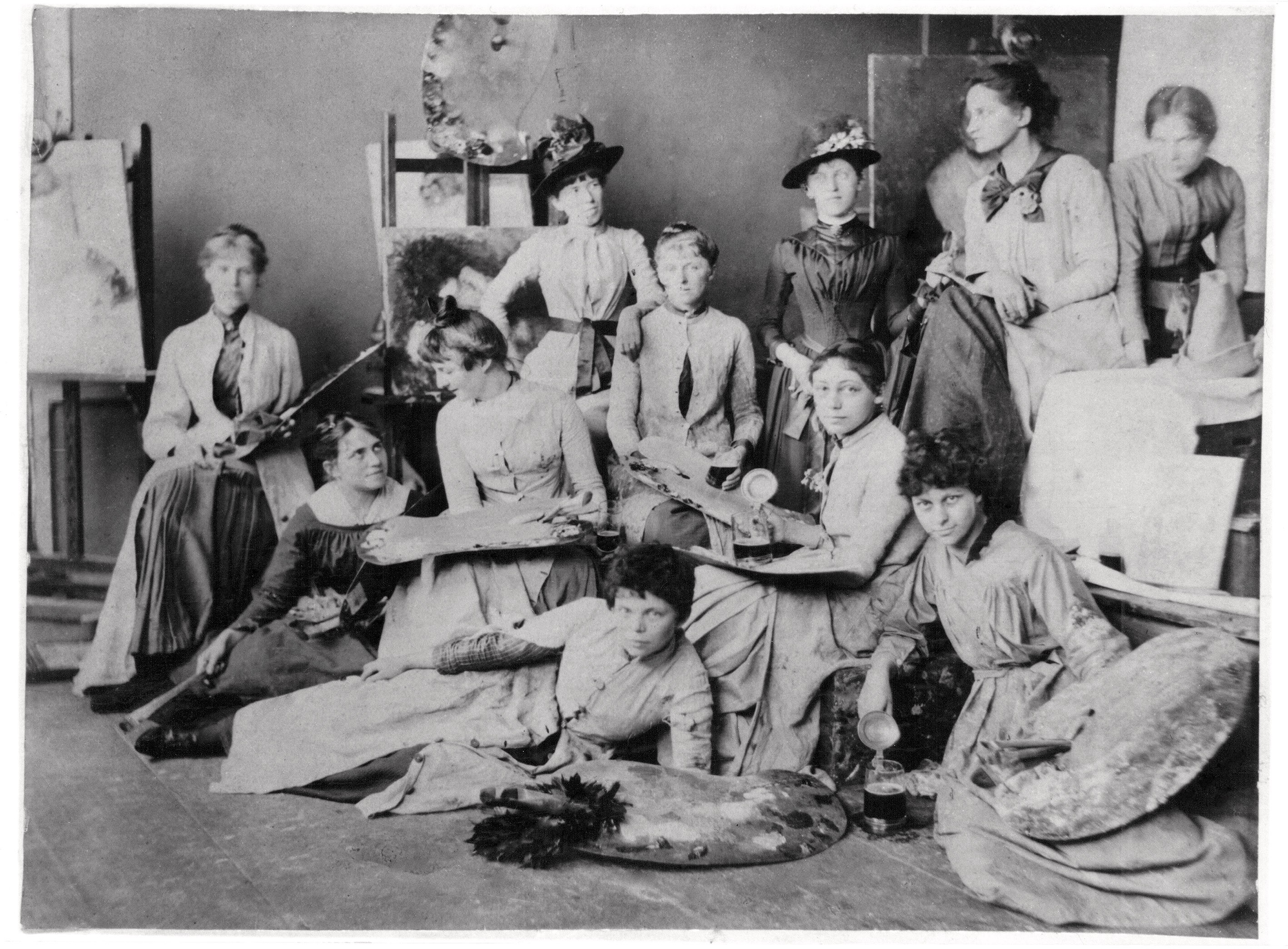
From October onwards, Käthe Kollwitz took classes with Ludwig Herterich (1856-1932) at the Munich Damenakademie des Künstlerinnen-Vereins where she studied for two years.
Herterich had acquired particular renown as a portrait artist and painter of monumental compositions and was a leading representative of the Munich School. His treatment of colour, which combined the artistic device of tone-on-tone painting with the lighter colour range used by naturalistic plein-air painters, was still unfamiliar to the young artist Käthe Kollwitz.
[Herterich’s] decidedly colouristic art did not chime with my feelings or my way of seeing colours. I used a trick to become one of his more respected pupils by painting in such a manner as I knew he wanted me to paint. […] During the day we were busy with our work, and in the evening we enjoyed ourselves, going to beer cellars, exploring the surrounding area and feeling free, as we had our own keys to the dormitory.«
In Munich, Käthe Kollwitz enjoyed the free life of an artist. Together with students from the Munich Academy she took part in private evening painting sessions that were organised by pupils from the Academy for Women. This was the only opportunity for the young women to practice multi-figure compositions.
A particular theme was set for these evenings. I remember the theme ›Fight‹. I chose a scene from [Emile Zola’s novel] ›Germinal‹ where two men fight over young Cathérine in a smoky tavern. My composition was met with approval. For the first time, I felt that my work was acknowledged and in my mind new vistas opened up. I couldn’t sleep that night because of my anticipation of happiness.«
While Käthe Kollwitz was studying in Munich, naturalistic plein-air painting with depictions of scenes from the lives of ordinary people began to assert itself. Its leading representatives were Fritz von Uhde (1848-1911) and Max Liebermann (1847-1935).
After finishing her studies in Munich and influenced by the art of Max Liebermann, who had a formative influence on Käthe Kollwitz, she began to represent characteristic situations of working-class life – initially without any social criticism. Looking back, she wrote:
My entire work pointed towards Socialism […] This was brought about by the attitudes of my father and my brother, by the entire literature of that period. However, the real motivation […] for choosing almost exclusively scenes from working-class life was that the motifs from that sphere of life […] conveyed the things that I found beautiful. […] I just want to emphasise […] that initially compassion and empathy played a very small role in my motivation to depict the life of the proletariat. It was rather because I simply found it beautiful. As Zola or somebody once said: ›Le beau c`est le laid.‹«
In Munich, Käthe Kollwitz occupied herself for the first time with the issue of women’s rights.
She encountered the same theme in the print cycle »A Life« by Max Klinger (1857-1920), published in 1884. This was the first work by Klinger that she came across during her studies in Berlin. The print cycle »A Love«, completed in 1887, which she probably saw in 1888 at the International Exhibition at the Glaspalast in Munich, also takes up this theme.
The students at the Art Academy for Women were enthusiastic about the Naturalist writers Henrik Ibsen (1828-1906) and Bjørnstjerne Bjørnson (1832-1910), above all because of their attitude towards the emancipation of women.
Käthe Kollwitz was also confirmed in her views by the Social Democratic politician August Bebel (1840-1913) whose speech she heard during a convention and whose book Die Frau und der Sozialismus she read. With 52 editions and numerous translations, this book was the best seller of socialist literature in the 19th century.
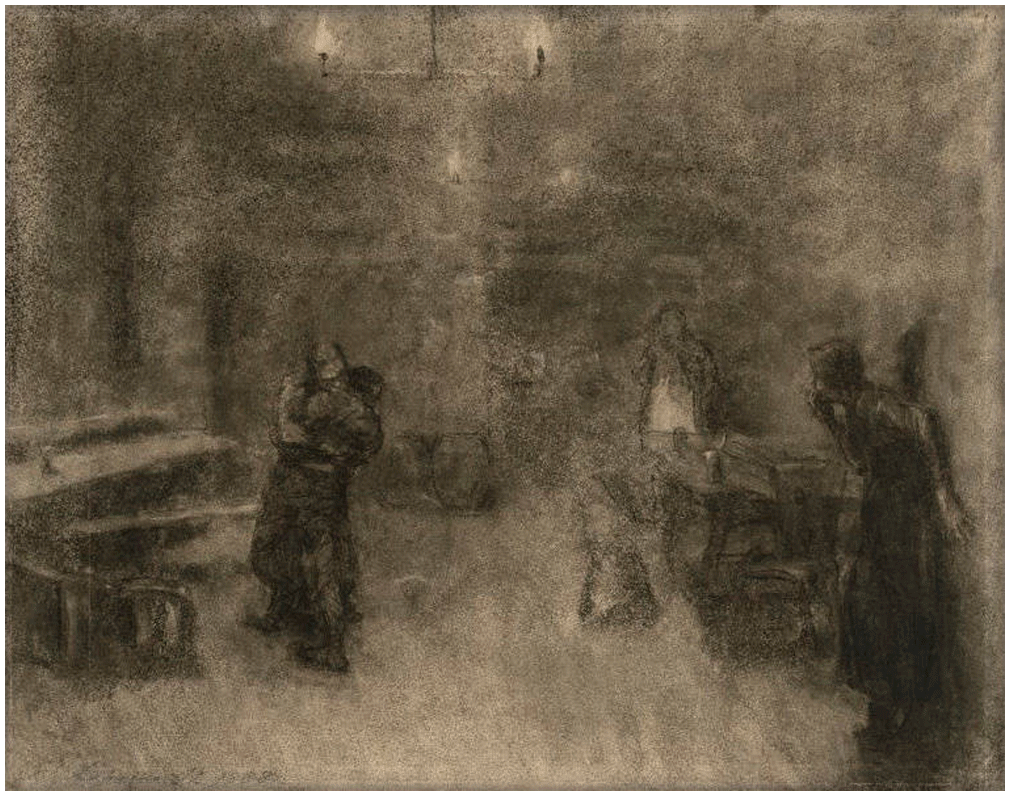
Works on the theme of gender debate.
First preparatory drawings on the fight scene from the novel Germinal by Emile Zola (1840-1902) in which two men fight over Cathérine – like in »Two Men Fighting in a Tavern«, NT 9 – ignore the social criticism of the novel and instead explore a drama of jealousy that is not at the centre of the plot.
Other early works such as the pen and ink drawing »A Woman’s Destiny«, NT (17a), addressed the misery that women experienced as a result of unwanted pregnancy. This was also a reference to the fate of Gretchen in Johann Wolfgang von Goethe’s (1749-1832) Faust.
This theme was taken up again in 1893 or earlier in the etching »Woman at the Church Wall«, Kn 17, and was used again in the late 1890s in a lithograph and an etching.
In the so-called Dreikaiserjahr (year of the three emperors) Wilhelm I (1797-1888) died on 9 March. After Friedrich III (1831-1888), who died on 15 June from cancer after 99 days on the throne, Wilhelm II (1859-1941) became German Kaiser.
On 18 February the Anti-Socialism Law was extended for the last time.
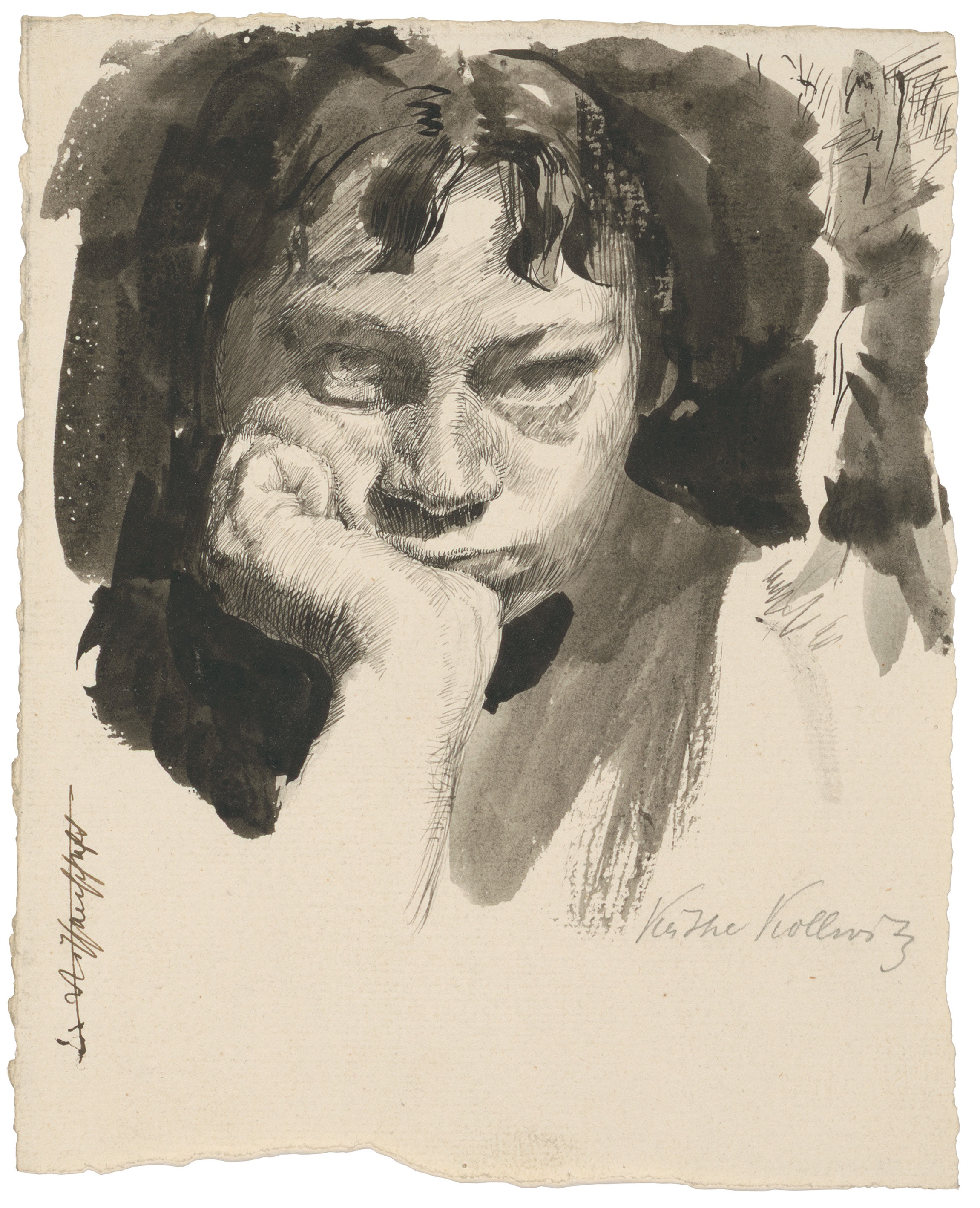
After her return from Munich, the artist rented her first studio in Königsberg.
She was a reader of the Berliner-Volks-Tribüne, the only Social-Democratic newspaper not made illegal by the Anti-Socialism Law. Her brother Konrad Schmidt (1863-1932) was the paper’s main editor for a brief period.
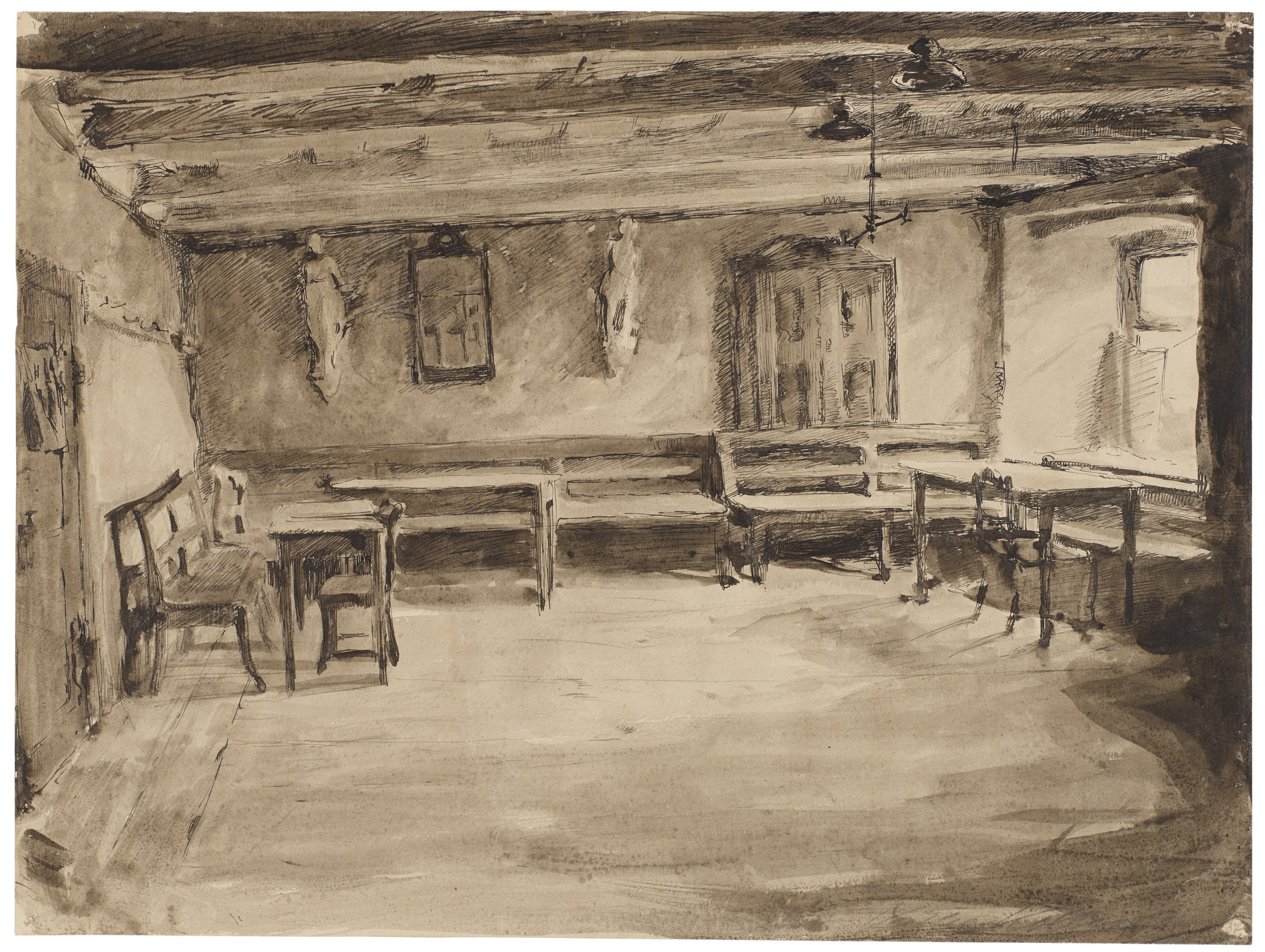
Kollwitz planned to execute the »Fight Scene«, NT 9, from the novel Germinal by Emile Zola (1840-1902) as a painting on canvas. She had drawn this scene in Munich in 1888. For this purpose she made preparatory interior studies in taverns in Königsberg that were frequented by sailors. An example is »Tavern in Königsberg«, NT (52a), a pen and ink drawing with grey wash.
This time […] I rented a small studio […] because I wanted to execute the scene from ›Germinal‹ on canvas. For this purpose, I needed to make studies. At that time Königsberg had a number of sailors’ taverns in the old Pregel districts. It was extremely dangerous to go there in the evening. It was only possible to make these studies in the late morning. I found the ›Schiffchen‹ the most interesting tavern. It had two exits. You could hear a terrible noise from inside. Stabbings happened on a daily basis.«
Later, however, she decided to execute the scene as an etching and for this purpose her first teacher, Rudolf Mauer, introduced her to printing techniques.
I have started to do etchings and have therefore made a lot of preparatory pen and ink drawings. I generally do far more drawings than paintings these days. This is simply practical thinking as I will hardly have enough money in the first few years of my marriage to be able to rent a studio. And the thought of painting in oil in a small flat that you live in is depressing. Making etchings is far less inconvenient.«
Otto von Bismarck (1815-1898) was released by Kaiser Wilhelm II (1859-1941) from his position as Chancellor, followed by a departure from Bismarck’s alliance policy.
The Anti-Socialism Law was not extended. Despite the introduction of the law in 1878, the Social Democrats tripled the number of followers to just under 1.5 million.
The Socialist Workers’ Party (SAP) became the Social Democratic Party of Germany (SPD) under August Bebel (1840-1913).